



Rapid Wrinkle Repair Eye Cream: What Works & What to Expect
“Rapid wrinkle repair” eye creams can make the under-eye area look smoother quickly through hydration, but meaningful changes in fine lines usually take longer. Moisturizers can temporarily soften the look of fine lines, while retinoids have stronger evidence for improving mild wrinkles over time.
The American Academy of Dermatology identifies retinoids as useful for mild fine lines and wrinkles, while the FDA distinguishes cosmetic claims such as making wrinkles look less noticeable through moisturizing from drug-like claims such as removing wrinkles or increasing collagen production. See AAD retinoid guidance and FDA wrinkle-claim guidance.
How fast can an eye product realistically work?
There are two different types of results to separate:
- Fast cosmetic smoothing: hydration can make fine lines look softer within minutes or hours.
- Longer-term change: retinoids and other active ingredients generally require consistent use over weeks or longer.
Be cautious with claims of permanent wrinkle repair in a few days. A cosmetic eye serum can improve appearance, but it should not promise structural wrinkle removal unless it is regulated and substantiated for that purpose.
Which ingredients have the strongest support?
Retinol and retinoids
Retinoids have some of the strongest topical evidence for mild fine lines, uneven tone, and texture. They can also irritate the eye area, so lower-strength products and gradual introduction are often more appropriate than aggressive use.
Moisturizing ingredients
Humectants and emollients such as hyaluronic acid, glycerin, squalane, and panthenol can temporarily plump dry skin and make fine lines appear less noticeable. Moisturizing itself is a legitimate cosmetic anti-aging strategy.
Peptides
Peptides are commonly used in formulas designed to support smoother, firmer-looking skin. Evidence varies by peptide and finished formulation, so they should not be described as guaranteed collagen rebuilders.
Vitamin C
Vitamin C can support visible brightness and antioxidant protection. It may be useful in an eye-area routine when the formula is well tolerated, but it is not a substitute for retinoids when wrinkle reduction is the main goal.
Caffeine
Caffeine is often used in eye products for a more refreshed look and may help temporarily reduce the appearance of puffiness. It should not be described as a wrinkle-removal ingredient.
A verified Glimmer Goddess eye serum option
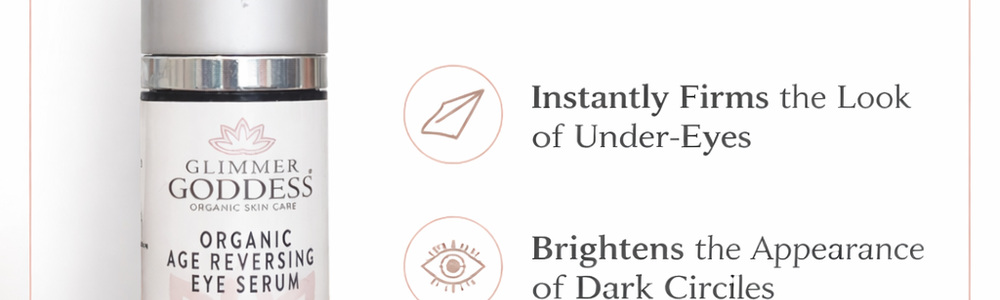
The Organic Age Reversing Eye Serum – Instant Firming Treatment is an active Glimmer Goddess eye product formulated with vitamin C, peptides, hyaluronic-acid-type hydration support, and botanical ingredients.
For this article, its positioning is intentionally conservative: it can be described as a lightweight eye serum designed to support a smoother, brighter, firmer-looking under-eye appearance.
This guide does not repeat unverified claims about “clinical-strength” peptide concentrations, guaranteed visible tightening in 30 minutes, permanent wrinkle repair, or proven collagen stimulation.
Eye serum vs eye cream
The difference is mostly texture and formulation, not a universal difference in effectiveness.
- Eye serum: usually lighter and easier to layer.
- Eye cream: usually richer and may provide more occlusive moisture.
Choose based on dryness, skin tolerance, and the active ingredients—not the product category name alone.
How to use an eye product without overdoing it
- Apply a small amount around the orbital area according to the product directions.
- Use gentle tapping or spreading rather than rubbing aggressively.
- Avoid applying so close to the eye that the product migrates into it.
- If the formula contains retinol, start gradually.
- Use broad-spectrum SPF 30 or higher every morning.
There is no requirement to use a pinky finger, wait 2–3 minutes between every layer, or allow exactly 15 minutes between skincare products unless the individual product directions say so.
Why sunscreen matters for under-eye wrinkles
Sun exposure accelerates visible aging, including fine lines and wrinkles. The AAD identifies daily sun protection as the foundation of an anti-aging routine.
Apply sunscreen carefully around the eye area using a formula that does not sting your eyes, and use sunglasses and hats for additional protection.
Can sensitive skin use wrinkle eye products?
Sometimes. Sensitive skin may do better with fragrance-free, simpler formulas and slower introduction of actives.
Retinoids are more likely to irritate dry, inflamed, or reactive skin, so people with significant redness or irritation should consider discussing retinoids with a dermatologist before using them around the eyes.
When an eye cream is not enough
Topical skincare can improve hydration, texture, and mild fine lines, but deeper wrinkles, volume loss, or loose skin may respond more to professional treatments.
The AAD lists prescription retinoids, fillers, botulinum toxin, chemical peels, laser resurfacing, ultrasound, and radiofrequency among options dermatologists may use for different signs of aging.
What to avoid
- Products promising permanent wrinkle removal in days.
- “Clinically proven” language without actual finished-product evidence.
- Claims that organic or natural automatically means safer for sensitive eyes.
- Using several retinoid products around the eyes at once.
- Continuing a product that repeatedly burns, swells, or causes persistent redness.
- Assuming higher price means faster results.
Frequently asked questions
Can an eye cream work instantly?
It can make fine lines look softer quickly through hydration or film-forming effects. That is different from permanently changing wrinkle depth.
How long does retinol take around the eyes?
There is no single timeline, but retinoids generally require consistent use over several weeks or longer. Start slowly because the eye area is easily irritated.
Are peptides as effective as retinol?
Not based on current evidence. Peptides can support smoother, firmer-looking skin, but retinoids have stronger evidence for mild fine lines and wrinkles.
Can I use eye serum morning and night?
Many non-retinoid eye serums can be used once or twice daily if tolerated. Follow the product directions.
When should I stop using an eye product?
Stop if you develop persistent burning, swelling, rash, or eye irritation. Seek medical care if symptoms are severe or affect vision.
Related Glimmer Goddess guides
- Under-Eye Wrinkles: What Eye Cream Can—and Can’t—Do
- How to Choose a Clean Eye Cream for Fine Lines in 2026
- Puffy Eyes & Dark Circles: Causes and What Can Help
- Explore Skincare by Skin Concern
This article is for general skincare education and is not a diagnosis or substitute for medical care.