



If you prefer a gluten-conscious beauty routine, choosing body care should still feel luxurious and simple. Whether you love the lightweight feel of lotion or the rich, cocooning texture of whipped body butter, the best formula should fit your ingredient preferences while also giving your skin the moisture, comfort, and texture it actually needs.
The Simple Answer
What Should You Look For in Gluten-Free Body Lotion or Body Butter?
A good gluten-free body lotion or body butter should be formulated without gluten-containing ingredients while still delivering the moisture, texture, and skin feel you want.
Look for clear ingredient information, nourishing moisturizers, a texture suited to your skin, and a brand that explains its formulation choices clearly rather than relying on fear-based claims.
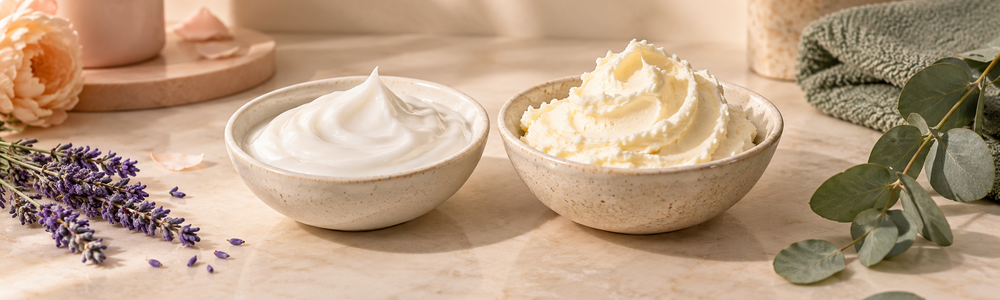
Body lotion is generally lighter and more fluid, while body butter is usually richer and more concentrated. Neither is automatically “better”—the right choice depends on how dry your skin feels, when you apply it, the climate, and the texture you enjoy using consistently.
Bottom line: choose gluten-conscious body care for both the ingredient profile and the skin experience—not for the label alone.
Browse qualifying facial and body-care formulas in the Glimmer Goddess® Gluten-Free Skincare Collection.
Body Lotion vs. Body Butter: What’s the Difference?
Body Lotion
Body lotion typically has a lighter, more fluid texture that spreads quickly across larger areas of the body.
It can be a strong choice for everyday hydration, warm weather, quick after-shower application, or anyone who prefers a lighter finish.
Best for: daily hydration, easy layering, quick absorption, and larger body areas.
Body Butter
Body butter is generally richer and more concentrated, often relying more heavily on plant butters and oils for a plush, conditioning feel.
It can feel especially indulgent on dry areas, during colder weather, after bathing, or as part of an evening body-care ritual.
Best for: richer moisture, dry-feeling skin, targeted areas, and nighttime care.
Which Texture Is Right for You?
Everyday Hydration
Choose lotion when you want fast application, easy spreadability, and a lighter finish for daily use.
Very Dry Skin
Choose a richer body butter when skin feels tight, rough, dry, or in need of more intensive conditioning.
Warm Weather
A lighter lotion may feel more comfortable when you want hydration without a heavier skin feel.
Nighttime Ritual
A rich whipped body butter can turn evening hydration into a more indulgent, slow-down self-care moment.
Look Beyond “Gluten-Free”: The Moisturizing Ingredients Matter Too
Gluten-free should be one part of your buying decision—not the only part. A beautiful body moisturizer should also contain ingredients that support softness, hydration, and a comfortable skin feel.
Plant Butters
Rich plant butters can help soften the feel of dry, rough skin and create the plush texture people love in body butter.
They are especially common in more concentrated, water-light or water-free body-care formats.
Botanical Oils
Plant-derived oils help provide emollience and can leave skin feeling smoother, softer, and more conditioned.
The specific oils used can also influence slip, richness, and overall texture.
Humectants & Hydrators
Water-based body lotions may include humectants that attract and hold moisture at the skin's surface.
These ingredients can help support a comfortable hydrated skin feel without requiring a very heavy texture.
Does Body Lotion Need to Be Gluten-Free for Celiac Disease?
Not necessarily for ordinary topical use. Current guidance from the Celiac Disease Foundation states that gluten is not absorbed through intact skin.
That means ordinary body lotion or body butter applied to healthy, intact skin is not treated the same way as eating gluten.
Some shoppers still prefer gluten-free body care because they value ingredient consistency, simplified shopping, or want to reduce concerns about accidental transfer to the mouth.
For the broader explanation, read Does Skincare Need to Be Gluten Free? and Can Gluten Be Absorbed Through Your Skin?.
Why Accidental Ingestion Matters More Than Skin Contact
Ordinary Body Application
Body butter on your legs, lotion on your arms, or moisturizer applied to intact skin represents ordinary topical contact.
For celiac disease, this is different from gluten being ingested.
Transfer to the Mouth
Hand products may deserve more attention if residue could transfer to food or the mouth before eating.
The practical concern is potential ingestion—not absorption through healthy skin.
What Does “Gluten-Free Body Lotion” Actually Mean?
Formulation Language
A gluten-free body lotion or body butter generally describes a formula made without gluten-containing ingredients from grains such as wheat, barley, rye, or related sources.
Clear product language helps shoppers understand the intended formulation approach.
Certification Is Different
Unless a product specifically states that it is third-party certified gluten-free, shoppers should not automatically interpret a cosmetic gluten-free claim as a certification.
Formulation claims and third-party certification are not the same thing.
Does the FDA Have a Gluten-Free Standard for Body Lotion?
Not in the same way it has a gluten-free standard for foods.
Food
The FDA defines the conditions under which foods may voluntarily use the term “gluten-free.”
Cosmetics
Body lotions and body butters follow cosmetic-labeling requirements rather than simply inheriting the food-labeling standard.
Cosmetic claims still need to be truthful and not misleading.
Which Ingredient Names Should Gluten-Conscious Shoppers Recognize?
If you prefer body care made without gluten-containing ingredients, start with the primary gluten-containing grain sources rather than trying to memorize every cosmetic term.
Wheat
Examples may include wheat protein, hydrolyzed wheat protein, wheat germ oil, or botanical terminology such as Triticum vulgare.
If wheat-derived ingredients matter to your shopping criteria, review the complete formulation.
Barley
Barley-derived ingredients may appear under common names or botanical terminology such as Hordeum vulgare.
Contact the manufacturer if product-specific sourcing is unclear.
Rye
Rye-derived ingredients may appear under terms such as Secale cereale.
Recognizing botanical names makes label reading faster and more practical.
Want the Ingredient Deep Dive?
Learn the main wheat-, barley-, rye-, and grain-derived ingredient names used across skincare.
Want the Step-by-Step Label Method?
Learn how to scan a skincare ingredient list and when to contact a manufacturer for clarification.
When Does a Rich Body Butter Make Sense?
A whipped body butter can be especially appealing when skin feels dry, tight, rough, or seasonally depleted.
Body Butter May Be a Great Fit If You Want
- A richer, more concentrated texture
- Extra comfort for dry-feeling skin
- Targeted care for elbows, knees, hands, or heels
- A more indulgent nighttime moisture ritual
- A longer-lasting moisturized skin feel than a very light lotion
Think About Consistency
The richest formula is only useful if you enjoy applying it.
If a heavy texture makes you skip body care entirely, a lighter lotion used consistently may serve your routine better.
The best texture is the one you will actually use.
When Is Body Lotion the Better Choice?
After Showering
Lotion spreads quickly across larger areas and can make full-body moisturizing easier when you are short on time.
Before Getting Dressed
A lighter finish can feel more convenient when you want comfortable moisture without waiting for a richer butter to settle.
Warm or Humid Weather
Lighter body lotion textures may feel more comfortable when you still want hydration but prefer less richness.
Do You Have to Choose Between Lotion and Body Butter?
No. Many body-care routines benefit from having both.
Morning
Use a lighter lotion when you want quick, comfortable hydration before getting dressed.
Evening
Reach for body butter when you want richer moisture and a more indulgent nighttime ritual.
Targeted Dry Areas
Use lotion all over, then layer body butter onto elbows, knees, hands, heels, or other areas that need extra conditioning.
Is Gluten-Free Body Care Better for Sensitive Skin?
Not automatically. Gluten-free tells you one thing about the ingredient profile; it does not tell you whether your individual skin will tolerate every other ingredient in the formula.
If Your Skin Is Sensitive
- Read the complete ingredient list
- Introduce new body products gradually
- Patch test when appropriate
- Pay attention to your individual skin response
- Discontinue use if significant irritation develops
Look at the Whole Formula
Texture, essential oils, botanical extracts, preservatives, ingredient concentration, and individual sensitivities can all influence how a body-care product feels on your skin.
The absence of gluten-containing ingredients does not override the rest of the formulation.
Gluten-Free, Vegan & Organic Body Care Are Different
Gluten-Free
Relates to gluten-containing ingredients and grain-derived sources in the formulation.
Vegan
Means a formula contains no animal-derived ingredients. Vegan does not automatically mean gluten-free.
Organic
Relates to the sourcing, production, handling, or certification of qualifying agricultural ingredients.
For the full comparison, read Gluten-Free vs. Vegan Skincare: What’s the Difference?.
Glimmer Goddess® maintains a strictly vegan formulation standard.
Your Gluten-Free Body Moisturizer Shopping Checklist
Formula Questions
- Is the complete ingredient list available?
- Is the gluten-conscious claim clearly explained?
- Are wheat-, barley-, or rye-derived ingredients present?
- Can the brand answer ingredient-source questions?
Skin Experience Questions
- Do I want a lotion or a richer body butter?
- Does the formula fit how dry my skin feels?
- Will I enjoy the texture enough to use it consistently?
- Does it fit my ingredient and scent preferences?
Where Does Body Care Fit in a Gluten-Free Skincare Routine?
Body care is often easiest to apply after bathing while skin still feels comfortable and slightly hydrated, but your routine does not need to follow one rigid schedule.
Use lotion when you want lighter everyday hydration, body butter when you want a richer finish, or both depending on the area and time of day.
See the complete facial-and-body routine in Best Gluten-Free Skincare Routine: Cleanser, Serum, Moisturizer & Body Care.
The Glimmer Goddess® Approach to Body Care
At Glimmer Goddess®, body care is part of the ritual—not an afterthought.
Our body-care assortment ranges from lighter lotions to rich whipped butters, giving you the freedom to choose the texture that feels best for your skin and your routine.
We focus on strictly vegan formulations, thoughtful ingredients, luxurious textures, transparent product information, and small-batch body care handcrafted in Texas.
For shoppers who prefer formulas made without gluten-containing ingredients, explore our Gluten-Free Skincare Collection.
Soft Skin, Thoughtful Ingredients, Your Perfect Texture
Explore qualifying Glimmer Goddess® vegan body care and skincare thoughtfully formulated without gluten-containing ingredients and handcrafted in Texas.
Shop Gluten-Free SkincareOur Editorial Standard
How This Guide Was Created
Body-Care Education Without Fear
This guide was created to help shoppers understand how gluten-conscious formulation fits into the larger decision of choosing a body moisturizer that actually feels good and works for their routine.
Grounded in Current Guidance
Celiac-related information was reviewed against Celiac Disease Foundation educational guidance. Regulatory distinctions were reviewed against U.S. Food and Drug Administration gluten-free food-labeling and cosmetic-labeling resources.
Glimmer Goddess® has created vegan skincare and body-care products since 2015, with an emphasis on ingredient transparency, thoughtful formulation, luxurious textures, and handcrafted Texas production.
Experience
Glimmer Goddess® develops body lotions, whipped body butters, and other body-care formulas and works directly with cosmetic ingredients and finished-product formulations.
Expertise
Ingredient and body-care information is reviewed against current product specifications and recognized regulatory or educational sources where applicable.
Authoritativeness
Celiac and cosmetic-labeling statements are supported by sources including the Celiac Disease Foundation and U.S. Food and Drug Administration.
Trustworthiness
We distinguish cosmetic performance, formulation preferences, medical guidance, and third-party certification.
Gluten-Free Body Lotion & Body Butter FAQs
What is gluten-free body lotion?
Gluten-free body lotion generally refers to a lotion formulated without gluten-containing ingredients derived from grains such as wheat, barley, rye, or related gluten-containing sources.
What is gluten-free body butter?
Gluten-free body butter generally describes a rich body moisturizer formulated without gluten-containing ingredients. Body butter typically has a richer, more concentrated texture than lotion.
Does body lotion need to be gluten-free for celiac disease?
Current Celiac Disease Foundation guidance states that gluten is not absorbed through intact skin. Ordinary body lotion therefore generally does not need to be gluten-free solely because someone has celiac disease.
Is body butter better than body lotion for dry skin?
Body butter is generally richer and more concentrated, so many people prefer it for very dry-feeling skin or targeted dry areas. Lotion may be more convenient for lightweight everyday hydration.
Can I use both body lotion and body butter?
Yes. You can use lotion for everyday all-over hydration and body butter on especially dry areas or as a richer evening body-care step.
Is gluten-free body lotion better for sensitive skin?
Not automatically. Gluten-free status does not determine whether a formula will suit sensitive skin. Review the complete ingredient list and pay attention to your individual skin response.
Does the FDA certify gluten-free body lotion?
No. The FDA's formal gluten-free definition applies to foods. Ordinary cosmetics such as body lotions and body butters follow separate cosmetic-labeling requirements.
Where can I shop Glimmer Goddess® gluten-free body care?
Browse qualifying body-care formulas in the Glimmer Goddess® Gluten-Free Skincare Collection.
Continue Your Gluten-Free Skincare Guide
Explore the Complete Gluten-Free Skincare Resource Center
Choose the topic that best matches your next question.
Start with the complete definition, ingredient overview, and shopping guide.
Understand the difference between medical necessity and personal preference.
Explore topical exposure, celiac guidance, and accidental ingestion.
Learn which grain-derived and botanical ingredient names may deserve closer review.
Follow a practical process for evaluating cosmetic ingredient declarations.
Choose facial hydration based on ingredients, skin needs, and texture.
Understand two commonly confused formulation terms.
Put cleanser, serum, moisturizer, and body care into the right order.
Explore qualifying Glimmer Goddess® facial and body-care formulas.
References
Celiac Disease Foundation: Gluten & Skin
FDA Gluten-Free Labeling Guidance
FDA Gluten and Food Labeling
FDA Cosmetics Labeling
Shop Glimmer Goddess® Gluten-Free Skincare