


Best Skin-Brightening Face Creams 2026: 5 by Skin Need
What is the best skin-brightening cream for your face in 2026? The answer depends on whether your priority is sun protection, visible dark spots, dryness, or skin sensitivity. A well-chosen cream may combine hydration with tone-focused ingredients, but no cream guarantees that every form of hyperpigmentation will disappear.
This guide compares five real cream or lotion products: Glimmer Goddess Organic Vitamin C Daily Moisturizer SPF 30, La Roche-Posay Mela B3 UV Daily Moisturizer SPF 30, Eucerin Radiant Tone Daily Lotion SPF 30, SkinMedica Even & Correct Dark Spot Cream, and CeraVe Skin Renewing Night Cream. Unlike a serum-focused comparison, this article explains the practical differences between daytime brightening SPF creams, active treatments, and simple overnight moisturizers.
Glimmer Goddess publishes this article and sells the first product. We did not independently test the five creams head-to-head. There is no evidence-based numerical winner or universal order of effectiveness. The original article's six partly generic or serum-based entries and fabricated scores have been replaced with a relevant five-product comparison.
Quick comparison: five brightening and supporting face creams
| Cream | Primary role | Key consideration |
|---|---|---|
| Glimmer Goddess Vitamin C Daily Moisturizer SPF 30 | Daily moisture, vitamin C positioning and SPF protection | Use adequate sunscreen amounts; review botanical ingredients |
| La Roche-Posay Mela B3 UV Daily Moisturizer SPF 30 | Melasyl, 5% niacinamide and sunscreen | Its specific claims are not transferable to other niacinamide creams |
| Eucerin Radiant Tone Daily Lotion SPF 30 | Thiamidol-based tone care with SPF | Check current regional packaging and sunscreen directions |
| SkinMedica Even & Correct Dark Spot Cream | Targeted tone-focused cream containing exfoliating acids | No built-in SPF; precautions for sensitive skin and pregnancy |
| CeraVe Skin Renewing Night Cream | Nighttime moisturization with ceramides and niacinamide | Supporting moisturizer, not a dedicated pigmentation product |
This is a comparison of functions and product fit, not a clinical efficacy ranking. Some creams contain SPF; another is an exfoliating treatment; another focuses mostly on comfort. Their differences matter when building a complete routine.
1. Glimmer Goddess Organic Vitamin C Daily Moisturizer SPF 30
Our Organic Vitamin C Daily Moisturizer SPF 30 – Brightening Formula is an active Glimmer Goddess Shopify product. It is positioned as a daily facial moisturizer combining plant-based vitamin C with broad-spectrum SPF 30. It offers a straightforward morning option for someone interested in radiance and everyday UV protection.
Who might like it: Shoppers who prefer the Glimmer Goddess botanical skincare philosophy and want a moisturizer-format morning step rather than a standalone serum. It may simplify a routine when used according to its sunscreen label.
What to check: An SPF moisturizer needs sufficient application and reapplication to deliver labeled protection. A thin dab for cosmetic hydration is not equivalent to sunscreen directions. The product should not be described as clinically guaranteed to erase dark spots, reverse aging, or provide the same visible-light protection as a tinted formula with iron oxides. Review the exact ingredient list if fragrance-sensitive or allergic to botanical extracts.
Transparency: Because Glimmer Goddess is the publisher, we are not presenting this cream as the result of independent first-place testing. Choose it based on its verified product role, formulation and your own tolerance.
2. La Roche-Posay Mela B3 UV Daily Moisturizer SPF 30
La Roche-Posay Mela B3 UV Daily Moisturizer is a distinct daytime formula featuring proprietary Melasyl and 5% niacinamide. The brand markets it for the visible appearance of uneven tone and provides product-specific consumer and clinical claims. It is not the same as the Mela B3 serum, which contains a different niacinamide percentage.
Who might like it: A shopper seeking both a pigment-focused ingredient and a sunscreen-labeled daily moisturizer in one product.
What to check: The manufacturer instructs generous application before sun exposure and reapplication at least every two hours while exposed. These instructions matter more than any promise that a small amount will act like a full sunscreen layer. “Dermatologist tested” does not mean everyone will tolerate it. Its manufacturer testing does not establish superiority over the other four products.
3. Eucerin Radiant Tone Daily Face Lotion SPF 30
Eucerin Radiant Tone Daily Lotion SPF 30 takes another tone-focused daytime approach. The brand describes using Thiamidol, its pigmentation-oriented ingredient, alongside broad-spectrum SPF 30. It is marketed for the appearance of uneven tone and dark spots associated with sun exposure and other factors.
Who might like it: Someone interested in comparing a Thiamidol-containing SPF moisturizer with other daily UV-protection creams. It is helpful to compare this exact formula rather than assume every Eucerin face lotion has identical benefits.
What to check: Local availability and formulas can change. Follow the actual package directions, especially for sunscreen amounts, timing and reapplication. Specific manufacturer result timelines are not universal guarantees, and ingredients that are comfortable for one person may still irritate another.
4. SkinMedica Even & Correct Dark Spot Cream
SkinMedica Even & Correct Dark Spot Cream is intended as a pigment-focused cream rather than an everyday sunscreen moisturizer. Manufacturer information describes exfoliating-acid components and additional sun-sensitivity precautions, making this a different kind of product from the first three.
Who might like it: A shopper specifically looking for an active treatment cream and willing to follow its instructions carefully rather than substitute it for moisturizer and SPF.
What to check: AHAs can increase sun sensitivity and cause irritation, particularly when combined with other exfoliants or retinoids. SkinMedica's own safety guidance cautions against use while pregnant, lactating or planning pregnancy. It has no labeled SPF, so appropriate sun protection is still essential. Avoid comparing its active-treatment role with ordinary moisturizer as though they were functionally identical.
5. CeraVe Skin Renewing Night Cream
CeraVe Skin Renewing Night Cream contains ceramides, hyaluronic acid, niacinamide and peptides. It is a fragrance-free nighttime moisturizer designed to support hydration and skin comfort rather than promise highly targeted pigmentation correction.
Who might like it: A shopper whose brightening routine causes dryness, or someone who simply needs a comfortable nighttime cream and prefers a straightforward formula.
What to check: The presence of niacinamide does not automatically make this a specialized dark-spot treatment. It is not sunscreen. People with very reactive skin can still respond to ingredients in fragrance-free products. A useful supporting moisturizer may be a better purchase than another strong active if dryness is the main problem.
Choosing the right brightening cream by skin concern
If you mainly want a fresher, more radiant appearance
Begin by asking whether the skin is simply dehydrated or whether pigmentation is present. Moisturization can make dry skin look smoother and more luminous fairly quickly, without changing melanin production. A cream containing vitamin C may suit a radiance goal, but routine comfort and sun protection are still foundational.
If you are managing flat marks after acne
Flat brown, gray or dark areas left after a breakout may be post-inflammatory hyperpigmentation. These are not necessarily true acne scars. Ongoing acne control, avoiding new irritation and consistent sunscreen use can matter as much as choosing a brightening ingredient. Read our guide to distinguishing acne scars from dark marks before assuming one product fixes both.
If you have sun-related spots
Repeated UV exposure can increase visible pigment changes. A dedicated SPF cream may make protection more convenient, but only if you use it according to labeling. Consider shade and protective clothing as well, especially during extended outdoor exposure.
If the pattern looks like melasma
Melasma may appear as larger or symmetrical patches and can be influenced by sun exposure, visible light and hormonal factors. It may need a dermatologist's diagnosis and a treatment plan that includes appropriate sun and visible-light protection. A cosmetic product should not be marketed as a guaranteed cure for melasma.
If your skin stings or reacts easily
Prioritize a simple, comfortable routine. A rich moisturizer may be preferable to a strong exfoliating acid treatment during irritation. “Natural” is not synonymous with safe for everyone; botanical scents and essential oils can be allergens. Do not deliberately use an irritating product because you believe stinging means it works.
Which ingredients actually matter?
Vitamin C
Some vitamin C formulas support the appearance of more even tone and provide antioxidant benefits. Different vitamin C derivatives, concentrations, pH environments and packaging vary significantly. Strong percentages alone do not prove superiority. Read our vitamin C skincare guide for practical formulation context.
Niacinamide
Niacinamide is common in moisturizers as well as targeted tone products. It is used for barrier-supportive and cosmetic brightening goals, but 5%, 10% and undisclosed concentrations should not be assumed clinically equivalent. Nor does increasing concentration guarantee fewer dark spots or greater tolerance.
Thiamidol and Melasyl
These are distinct, brand-specific ingredients associated with Eucerin and La Roche-Posay products respectively. The manufacturers publish claims for their own formulations. Those claims should not be generalized to other formulas containing unrelated actives, nor treated as evidence of an independent comparative winner.
Exfoliating acids
Alpha hydroxy acids can address dull-looking surface texture, but they may also increase irritation or sun sensitivity. A product with acids needs its own precautions, especially if combined with retinol or other actives. Exfoliation is not automatically necessary to make a brightening product work.
Barrier-supporting moisturizers
Ceramides, glycerin, emollients and hyaluronic acid help improve the feel of dry skin and reduce water loss. They do not need to be purchased as separate products if your cream already provides comfortable hydration. A supportive night cream often makes an active-focused daytime routine easier to tolerate.
Sun protection and visible light: the essential distinction
The American Academy of Dermatology recommends broad-spectrum SPF 30 or higher sunscreen as a foundation for addressing dark spots. For certain pigmentation patterns, especially in deeper skin tones, tinted sunscreen containing iron oxides can offer additional protection from visible light. Untinted SPF moisturizers should not automatically be assumed equivalent for that purpose.
Apply sunscreen in the quantity and frequency on its package. Reapply during outdoor exposure as directed. No vitamin C serum, nighttime face cream or exfoliating treatment replaces an appropriately labeled sunscreen.
How to use a brightening cream in a routine
Morning
- Cleanse gently if needed; avoid aggressive scrubbing.
- Apply one optional treatment serum, following its directions.
- Apply a moisturizer if needed. If it contains SPF, follow sunscreen application and reapplication instructions rather than using a minimal cosmetic amount.
- Use hats, shade and other sun protection as appropriate.
Evening
- Remove sunscreen and makeup with a suitable cleanser.
- Use any exfoliating or retinoid product only as directed and avoid stacking multiple irritating products.
- Apply a comfortable nighttime moisturizer.
- Stop products causing persistent burning, swelling or rash and consult a professional when needed.
A toner is optional. There is no universal need to wait exactly 60 seconds between layers or to use every active mentioned in a buying guide. A predictable routine that the skin tolerates may serve you better than six new treatments at once.
What about the Glimmer Goddess brightening serums?
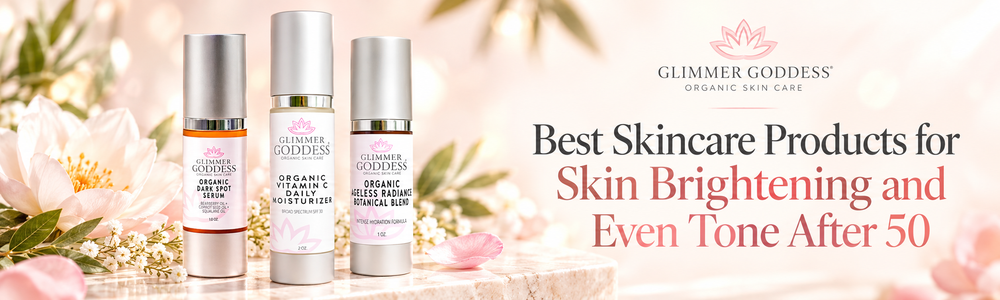
Our Organic Vitamin C Serum 20% and Organic Dark Spot Serum are separate options for shoppers seeking targeted cosmetic serum steps, rather than face creams. They were incorrectly included as “cream” entries in the original article. Their available ingredients, directions and claims should be checked individually. You do not need to add both to a routine simply because they appear in related skincare articles.
Glittering descriptions such as “clinical strength,” “safe for every sensitive skin type,” and “free of harsh chemicals” do not establish results or tolerance. Our goal is to help shoppers choose the actual product they need and understand its limitations.
Realistic expectations and when to seek professional advice
Moisturization effects can be noticeable quickly, while visible changes in pigmentation may take substantially longer. The AAD reports that some superficial marks can take six to twelve months to fade once the underlying cause is controlled, and deeper pigment may persist longer. Manufacturer timelines apply to particular studies and should not become guarantees for everyone.
A new, changing, irregular or bleeding spot needs professional assessment. See a dermatologist about persistent melasma-like patches, severe pigmentation, ongoing acne or irritation that does not improve. Prescription treatment or professional procedures may be appropriate depending on the actual diagnosis.
Frequently asked questions
Is a face cream better than a serum for dark spots?
No particular format is automatically more effective. Creams often combine hydration with actives, while some serums emphasize targeted ingredients. The whole formula and your tolerance matter more than the label.
Does vitamin C make skin more sun-sensitive?
Vitamin C itself is not generally classified as a photosensitizing ingredient in the way some exfoliating acids can be. Sunscreen remains necessary because sunlight contributes to pigmentation and skin damage—not because vitamin C automatically causes photosensitivity.
Can I use a brightening SPF cream as my sunscreen?
Yes, if the product has appropriate sunscreen labeling and you apply and reapply it according to those directions. Using a very thin layer may not provide the labeled protection.
Should I choose a moisturizer with niacinamide?
It can be a useful ingredient for hydration-supportive routines and an even-looking complexion. No single ingredient guarantees a specific visible outcome.
Can skin-brightening cream erase melasma?
No cosmetic cream guarantees that melasma disappears. A dermatologist can help determine a suitable approach, including medical treatment and sun or visible-light protection.
Can I use several brightening products together?
Sometimes, but more products are not necessarily better. Introduce new actives one at a time and pay attention to compatibility and irritation. Seek guidance for prescription products or complex regimens.
Which cream should I use if my skin is very dry?
A rich, comfortable moisturizer may be the priority. You can consider a separate targeted product later if your skin tolerates it and your pigmentation concern warrants it.
Further reading from Glimmer Goddess
For a different shopping question, see our six face moisturizers for dark spots comparison, dark spot serum comparison and complete brightening routine guide. These explore product formats and skincare routines more broadly.
Editorial disclosure: Glimmer Goddess® publishes this guide and sells products mentioned here. The five products are compared by function and manufacturer-described features; we have not conducted independent clinical head-to-head trials or assigned numerical scores. This article is educational rather than individualized medical advice.