




Article: Best Dark Spot Serums in 2026: Compare 4 Options
Best Dark Spot Serums in 2026: Compare 4 Options
Which dark spot serum should you choose in 2026? Look for a formula that suits the source of your discoloration, your skin's tolerance, and the rest of your routine. Common options include niacinamide and alpha arbutin for the appearance of uneven tone, azelaic acid for blemish-prone skin, retinol for post-breakout marks and texture, and vitamin C for visible brightness. A serum is only one part of the routine: broad-spectrum SPF 30 or higher and gentle skin care matter just as much.
This is a Glimmer Goddess brand-authored comparison, not an independent laboratory ranking. We compare four named options using manufacturer-listed ingredients, product positioning, application considerations and important limitations. We have not performed head-to-head clinical testing, and the order below does not represent measured efficacy scores.
At a glance: Four dark spot products compared
| Product | Notable approach | Consider if... | Keep in mind |
|---|---|---|---|
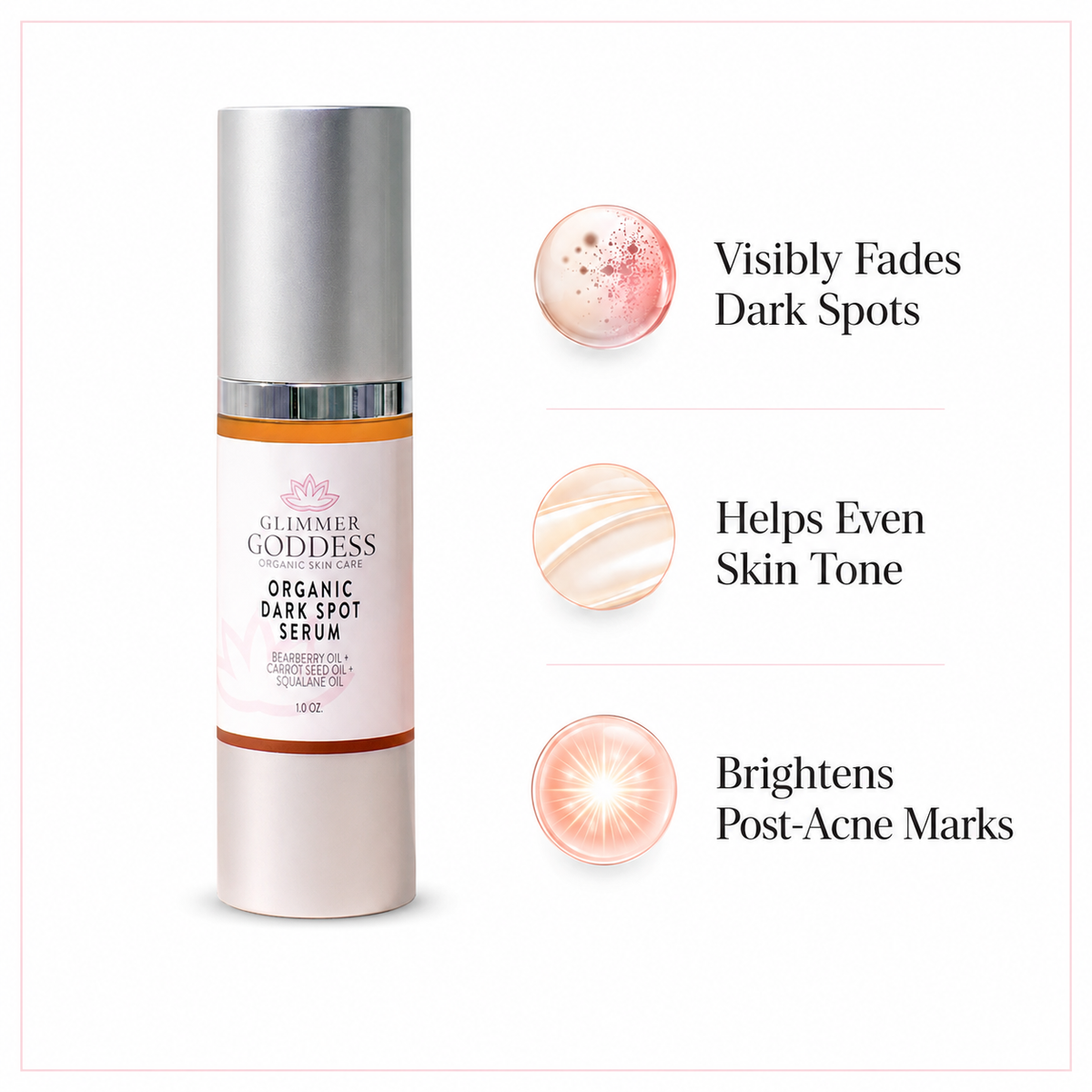
| Glimmer Goddess Organic Dark Spot Serum | Alpha arbutin, niacinamide and plant-based vitamin C | You prefer a multi-ingredient cosmetic brightening serum | Patch-test; naturally derived does not mean non-irritating |
| La Roche-Posay Mela B3 Serum | Melasyl and 10% niacinamide | You want a targeted discoloration formula | Contains fragrance; check the complete ingredient list |
| The Ordinary Azelaic Acid Suspension 10% | 10% azelaic acid | You want a focused azelaic-acid option | Formulation texture and tolerability vary by person |
| CeraVe Resurfacing Retinol Serum | Encapsulated retinol, niacinamide and ceramides | Post-breakout marks and uneven-looking texture are priorities | Introduce retinoids slowly; avoid during pregnancy |
Why dark spots develop
Dark spots are areas of increased pigmentation. They may develop after blemishes or inflammation, with sun exposure, or alongside hormonal changes. The pattern matters: a leftover spot after a breakout is not the same as persistent, symmetrical patches of melasma, and neither should be assumed to be a harmless cosmetic concern without examination when the appearance is unusual or changing.
Some discoloration fades slowly even without a serum. The American Academy of Dermatology notes that superficial dark marks may take months to improve, and deeper pigment can persist longer. Be wary of any product promising that all types of pigmentation disappear within a few weeks.
Four options, with realistic strengths and trade-offs
1. Glimmer Goddess Organic Dark Spot Serum: Multi-ingredient cosmetic brightening
Best fit: Shoppers looking for a Glimmer Goddess formula that combines several ingredients associated with improving the appearance of uneven tone. Our currently listed Organic Dark Spot Serum describes alpha arbutin, niacinamide and plant-based vitamin C. Alpha arbutin is used in cosmetics for visible tone concerns; niacinamide is used for barrier support and the look of discoloration; vitamin C is valued for antioxidant and visible-brightening properties.
Why consider it: It offers a convenient combination of brightening approaches in one step rather than asking the customer to layer several strong treatments. Glimmer Goddess makes skincare in small batches in the United States and positions the collection around naturally derived ingredients.
Points to consider: Ingredient science is not the same as head-to-head clinical proof for this finished serum. Botanical extracts and essential oils can still bother reactive skin. Check the product's current full ingredient list, follow its directions, and patch-test first. We do not claim this product is universally safe for sensitive skin or that it treats melasma as a medical condition.
2. La Roche-Posay Mela B3 Serum: Melasyl and 10% niacinamide
Best fit: Shoppers interested in a targeted discoloration product from a brand that publishes product-specific study information. La Roche-Posay identifies Melasyl and 10% niacinamide as key ingredients. Its own site reports results from studies of its formulation; those are brand-provided findings, not comparative testing against the products in this article.
Why consider it: Detailed disclosures and a defined focus on the appearance of persistent spots can help customers decide whether it belongs in their routine. Points to consider: The published ingredient list includes fragrance, so someone avoiding fragranced facial products should review that before purchase. No formula is irritation-free for everyone. Read the official Mela B3 product information.
3. The Ordinary Azelaic Acid Suspension 10%: A focused single-active option
Best fit: Shoppers seeking an azelaic-acid-centered skincare step, especially when uneven-looking tone occurs alongside a tendency toward blemishes. Azelaic acid has dermatologic applications, but this particular cosmetic product should be assessed according to its own label and directions.
Why consider it: A defined active concentration makes the choice straightforward and may appeal to customers who prefer a simpler treatment step. Points to consider: Concentration alone does not predict results or tolerability; suspension texture may not suit every routine. Introduce gradually and do not assume it can replace medical care for acne or rosacea. The manufacturer notes formulations may change, so review the packaging and current product information.
4. CeraVe Resurfacing Retinol Serum: Post-breakout marks and texture
Best fit: People whose main goals include the look of post-acne marks, uneven texture and visible pores. CeraVe describes encapsulated retinol along with niacinamide and ceramides in this serum. Retinol can be useful in a skincare routine, but it may cause dryness or irritation when introduced too quickly.
Why consider it: Its focus extends beyond pigmentation to the feel and appearance of skin texture. Points to consider: Use retinoids as directed, introduce them cautiously and use sun protection. Avoid retinoids in pregnancy unless your clinician specifically directs otherwise. The maker's product page provides the appropriate product details.
How to choose based on your skin
For discoloration following breakouts
First address ongoing irritation and avoid picking. Post-inflammatory marks can linger after a blemish heals, so prevention and patience are part of the plan. A well-tolerated brightening serum may support a more even-looking complexion, while retinol or azelaic acid products may be relevant depending on sensitivity and medical history.
For sun-related spots or an uneven-looking complexion
Prioritize daily sun protection before adding multiple serums. Choose a treatment you will comfortably use for an extended period and avoid harsh scrubs, which can inflame skin. Spots that are new, changing, bleeding or otherwise concerning should be evaluated instead of self-treated.
For easily irritated skin
Fragrance-free can be a useful selection criterion, although it does not guarantee tolerance. Use a small patch-test area, begin with one new treatment at a time and stop using a product that causes persistent burning, rash or significant redness. A dermatologist can help distinguish sensitivity from an underlying skin condition.
For suspected melasma
Melasma may require a dermatologist-led plan. The American Academy of Dermatology recommends careful sun protection and notes that a tinted sunscreen containing iron oxides may be especially helpful against visible light. Cosmetic serums are not substitutes for diagnosis or prescribed treatment.
The key ingredients explained
Niacinamide is a form of vitamin B3 found in many skincare formulas. It is commonly used to support the barrier and improve the appearance of uneven skin tone. The full formulation matters more than the presence of the ingredient alone.
Alpha arbutin is included in some cosmetic brightening products for uneven-looking pigmentation. Product concentration, formulation and tolerability matter; do not assume all alpha-arbutin products perform alike.
Vitamin C is used for antioxidant skincare and visible radiance. Its derivatives vary in stability and formulation, so a product labeled “vitamin C” is not automatically comparable to another one.
Azelaic acid is a relevant ingredient in discussions of pigmentation and blemish-prone skin. Seek professional guidance for medical concerns rather than treating cosmetic marketing as medical advice.
Retinol is a vitamin A derivative commonly used for the look of texture and post-breakout marks. Start slowly, moisturize, and do not use retinoids during pregnancy without medical guidance.
A practical routine for more even-looking skin
- Cleanse gently. Use a cleanser that leaves skin comfortable, not tight or stripped.
- Choose one focused treatment. Follow the exact product directions rather than automatically applying every serum twice daily.
- Moisturize. Support the skin barrier, especially when using stronger actives.
- Apply broad-spectrum SPF 30 or higher every morning. Reapply as directed when outdoors. Consider a tinted sunscreen containing iron oxides for pigmentation concerns.
- Review your response gradually. Photograph the area consistently, in similar lighting, rather than judging daily changes. Stop and seek advice if irritation persists.
Find related reading in our dark spots skincare guide, our moisturizer comparison, and our vitamin C ingredient guide. You can also explore the skincare-by-concern guide to build a balanced routine.
Frequently asked questions
How long does a dark spot serum take to work?
There is no universal timeline. Some cosmetic changes may be noticeable after several weeks, while deeper pigmentation can take many months to fade. Consistent sun protection and managing irritation are essential; finished-product evidence matters more than broad timelines.
Does natural mean suitable for sensitive skin?
No. Natural or organic ingredient positioning does not guarantee that a formula will be well tolerated. Check the complete ingredient list and patch-test, particularly if your skin reacts to fragrance or essential oils.
Can I combine vitamin C, retinol and azelaic acid?
Sometimes a clinician may recommend a multi-active routine, but combining several new actives at once increases the chance of irritation and makes it hard to know what helped. Begin with one and follow product-specific instructions.
Should I use a serum in the morning or evening?
Follow the product label. Retinol is typically used at night; many vitamin C or niacinamide products can fit a morning routine. Sun protection is important regardless of when a serum is applied.
When should I see a dermatologist?
Seek evaluation for spots that change in shape or color, bleed, appear suddenly without explanation, or persist despite appropriate care. A dermatologist can also help evaluate melasma, post-inflammatory pigmentation and irritation.
Our editorial conclusion
There is no credible single winner for every person. The most useful serum is one whose ingredients, directions, texture and tolerance fit your needs. The Glimmer Goddess Organic Dark Spot Serum is our own multi-ingredient cosmetic brightening option; the three other products illustrate different approaches. This article is written by the Glimmer Goddess brand, does not include comparative clinical testing and should not be mistaken for independent product scoring.
Sources and further reading: American Academy of Dermatology: How to fade dark spots; AAD: Melasma diagnosis and treatment; and manufacturer product information linked above.

