


Organic Facial Serum for Fine Lines: 7 Best Picks
Table of Contents
- Quick Comparison: 7 Facial Serums for Fine Lines
- How to Choose a Serum for Fine Lines
- 1. Organic Hyaluronic Acid Serum
- 2. Organic DMAE Firming Serum
- 3. Organic Resveratrol Serum
- 4. Organic Apple Stem Cell Serum
- 5. Organic Copper Peptide Serum
- 6. Organic Niacinamide Serum 5%
- 7. Organic Pumpkin Enzyme Serum
- How to Layer Facial Serums
- What to Look for in an Organic Facial Serum
- Frequently Asked Questions
Last Updated: October 1, 2026
The best facial serum for fine lines depends on why those lines look more noticeable in the first place. Dehydrated skin may benefit most from a humectant such as hyaluronic acid, while someone concerned with visible firmness may prefer peptides, DMAE or antioxidant-rich formulas. Uneven tone, enlarged-looking pores and dullness may point toward a different serum altogether.
Rather than choosing the product with the longest ingredient list, start with your primary concern and select a formula that fits comfortably into a simple routine. Moisturizer and daily broad-spectrum sunscreen remain important foundations because hydration can soften the appearance of fine lines, while unprotected UV exposure contributes to premature visible skin aging.
This guide compares seven current Glimmer Goddess® facial serums so you can understand how their formulas differ and choose the one that best fits your skin goals.
Quick Comparison: 7 Facial Serums for Fine Lines
| Serum | Current Price* | Key Formula Features | A Good Fit For |
|---|---|---|---|
| Organic Hyaluronic Acid Serum | $24.95 | Hyaluronic acid, white tea, amla extract, rosehip oil | Dehydration and temporarily more noticeable fine lines |
| Organic DMAE Firming Serum | $24.95 | DMAE, alpha lipoic acid, hyaluronic acid, botanical extracts | Firmer- and smoother-looking skin |
| Organic Resveratrol Serum | $34.95 | Resveratrol, CoQ10, alpha lipoic acid and antioxidant ingredients | Antioxidant support and radiant-looking skin |
| Organic Apple Stem Cell Anti-Aging Serum | $44.95 | Apple, lingonberry, orchid and orange plant stem cell ingredients plus hyaluronic acid | Hydration and a plant-based anti-aging routine |
| Organic Copper Peptide Serum | $44.95 | GHK-Cu, Argireline®, Matrixyl 3000, Palmitoyl Tripeptide-5, hyaluronic acid | Fine lines, expression-line appearance and firmer-looking skin |
| Organic Niacinamide Serum 5% | $34.95 | 5% niacinamide | Uneven-looking tone, visible pores, shine and fine-line appearance |
| Organic Pumpkin Enzyme Serum | $24.95 | Pumpkin seed oil, vitamin E, macadamia oil, carrot seed oil and rosehip oil | Dullness, nourishment and radiant-looking skin |
*Prices shown were current when this guide was reviewed and may change.
How to Choose a Facial Serum for Fine Lines
Fine lines can look more noticeable for several different reasons, including dehydration, dryness, cumulative sun exposure and normal changes in skin structure over time. That is why there is no single facial serum that is automatically the right choice for everyone.
A useful first step is to ask what else you notice about your skin:
- Dry or dehydrated? Start with hydration.
- Concerned with loss of visible firmness? Consider DMAE or peptide-based formulas.
- Dull or environmentally stressed? Antioxidant formulas may be a better fit.
- Uneven-looking tone or enlarged-looking pores? Niacinamide may address several concerns at once.
- Wanting a richer botanical serum? Plant oils and stem-cell-containing formulas may suit your preferred routine.
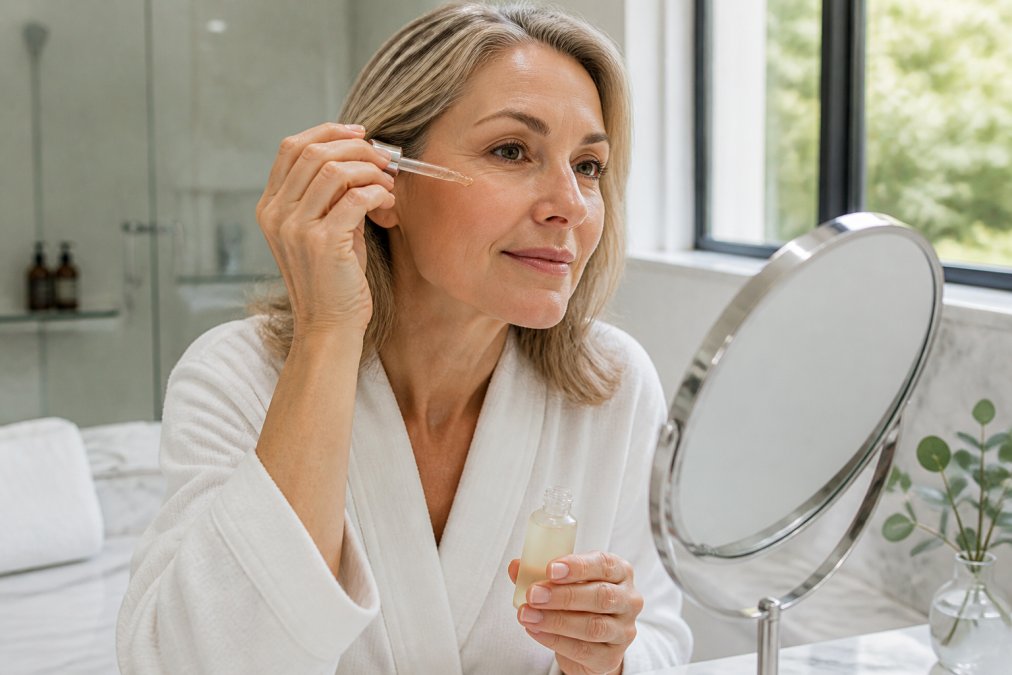
The American Academy of Dermatology recommends daily broad-spectrum SPF 30 or higher and regular moisturizer as two foundational steps for reducing visible signs of premature skin aging. Serums can complement those basics rather than replace them.
1. Organic Hyaluronic Acid Serum: For Dehydrated, Fine-Line-Prone Skin
Organic Hyaluronic Acid Serum – Plumping Hydration 1 oz. is the most straightforward choice in this group when dehydration is making fine lines look more pronounced.
Hyaluronic acid is a humectant, meaning it attracts and holds water. Topical hyaluronic-acid-containing products are widely used to improve skin hydration, and better hydrated skin can look smoother and more supple.
The Glimmer Goddess® formula combines vegan hyaluronic acid with white tea extract, amla extract, rosehip oil and vegetable glycerin.
Consider this serum if: your skin frequently feels tight or dehydrated and your priority is a smoother, more moisturized appearance.
2. Organic DMAE Firming Serum: For Firmer-Looking Skin
Organic DMAE Firming Serum – Natural Facelift Treatment combines DMAE with alpha lipoic acid, hyaluronic acid and botanical ingredients.
Its cosmetic focus is different from a purely hydrating serum: it is formulated for shoppers looking for smoother, firmer-looking skin and improved visible definition.
The original GrandRanker article described this product as appropriate for “sagging jawlines” and promised fast tightening. A more useful expectation is to view it as a cosmetic firming serum rather than a substitute for procedures that physically lift tissue.
Consider this serum if: your main goal is the appearance of firmness and smoother-looking skin rather than hydration alone.
3. Organic Resveratrol Serum: For Antioxidant Support & Radiance
Organic Resveratrol Serum – Instant Firming is built around antioxidant ingredients including resveratrol, CoQ10 and alpha lipoic acid.
Antioxidants are commonly incorporated into skincare formulas designed to help defend against oxidative environmental stress and support brighter, healthier-looking skin.
This makes the Resveratrol Serum a logical choice for someone whose goals include radiance and antioxidant support in addition to the appearance of fine lines.
Consider this serum if: dullness and environmental exposure are high on your concern list.
4. Organic Apple Stem Cell Serum: For a Botanical Anti-Aging Routine
Organic Apple Stem Cell Anti-Aging Serum contains plant stem cell ingredients from apple, lingonberry, orchid and orange along with hyaluronic acid, botanical oils and antioxidant ingredients.
It is best understood as a hydrating botanical anti-aging serum rather than a direct replacement for a retinoid. Plant stem cell ingredients and Vitamin A derivatives are not interchangeable ingredients and do not work through identical mechanisms.
The formula also contains essential oils of sweet orange, bergamot and vanilla, so shoppers with highly reactive skin or known sensitivities to essential oils should review the ingredient list carefully before use.
Consider this serum if: you enjoy botanical-rich formulas and want hydration plus plant-derived anti-aging ingredients.
5. Organic Copper Peptide Serum: For Peptide-Focused Fine-Line Care
Organic Copper Peptide Serum – Firming & Smoothing has one of the most targeted peptide complexes in the group.
The formula includes GHK-Cu (Copper Tripeptide-1), Argireline®, Matrixyl 3000, Palmitoyl Tripeptide-5, vegan hyaluronic acid, squalane and CoQ10.
These ingredients make it particularly relevant for shoppers focused on smoother-looking expression areas and firmer-looking skin.
The serum is available in both a lightly scented essential-oil version and an unscented/fragrance-free option without added essential oils, making the latter useful for shoppers who intentionally avoid fragrance ingredients.
Consider this serum if: peptides are the centerpiece of your fine-line routine or you want a fragrance-free peptide option.
6. Organic Niacinamide Serum 5%: For Uneven Tone, Visible Pores & Fine Lines
Organic Niacinamide Serum 5% – Pore Minimizer & Anti-Aging Treatment is a versatile option for someone whose concerns extend beyond fine lines.
Niacinamide, a form of vitamin B3, is widely used in skincare for barrier support and improvement in the appearance of uneven tone, visible pores, dullness and excess shine.
The 5% Glimmer Goddess formula makes this one of the most multipurpose choices in the comparison.
Consider this serum if: fine lines are only one concern and you are also focused on visible pores, uneven-looking tone or shine.
7. Organic Pumpkin Enzyme Serum: For Nourishment & Radiant-Looking Skin
Organic Pumpkin Enzyme Serum – Exfoliating Glow Treatment is substantially different from the water-based treatment serums above.
The current ingredient list includes pumpkin seed oil, vitamin E, macadamia oil, carrot seed oil, rosehip oil, vegetable glycerin and essential oils.
Although the product name includes “Enzyme Serum,” the current ingredient declaration does not list a separate pumpkin fruit enzyme ingredient. For that reason, it is more accurate to describe the formula by the ingredients actually present rather than claiming that fruit enzymes chemically dissolve surface cells.
This richer formula is better positioned as an oil-based botanical treatment supporting nourishment, softness and radiant-looking skin.
Consider this serum if: your skin feels dull or dry and you prefer a richer botanical oil treatment.
How to Layer Facial Serums Into a Routine
You do not need to use all seven serums—and for most people, doing so would make the routine unnecessarily complicated.
A practical routine generally starts with cleansing, followed by the treatment products you actually need, moisturizer when appropriate and sunscreen as the final morning skincare step.
- Cleanse gently. Avoid leaving the skin feeling excessively stripped or tight.
- Apply your targeted serum. Follow the directions for that specific product.
- Add a second compatible serum only if it serves a different need. More products do not automatically produce better results.
- Follow with moisturizer when your skin needs additional hydration and barrier support.
- Use broad-spectrum SPF 30 or higher every morning. UV exposure contributes to premature signs of skin aging, including wrinkles and uneven pigmentation.
Build Around Your Primary Concern
Instead of buying a different serum for every possible concern, choose one primary goal and build from there.
- For dehydration: begin with Hyaluronic Acid Serum and a moisturizer that suits your skin.
- For visible firmness: consider DMAE Firming Serum or Copper Peptide Serum.
- For antioxidant support and radiance: consider Resveratrol Serum.
- For visible pores and uneven-looking tone: consider Niacinamide Serum 5%.
- For a botanical-rich routine: consider Apple Stem Cell Serum.
- For a richer, oil-based glow treatment: consider Pumpkin Enzyme Serum.
Combining Active Ingredients
Online skincare advice often presents ingredient combinations as universal “never mix” rules. In practice, finished formulations, concentrations and individual tolerance matter.
A better approach is to:
- introduce one new active formula at a time;
- follow the directions for the finished product;
- avoid introducing several potentially irritating products simultaneously;
- reduce frequency if persistent burning, stinging, redness or peeling develops; and
- ask your dermatologist or prescribing clinician how to combine cosmetic serums with prescription skincare.
Copper peptides, exfoliating products and antioxidant serums are not automatically incompatible simply because they appear together in generalized internet lists. If your routine becomes complicated enough that you need a chart to remember which product goes on which night, simplifying it is often the better choice.
What to Look for in an Organic Facial Serum
The word organic does not by itself tell you whether a facial serum is right for fine lines. Look at the whole formula and how it matches your skin.
1. A Clear Primary Purpose
A good product should make it reasonably easy to understand whether it is primarily designed for hydration, antioxidant support, visible firmness, uneven-looking tone or another cosmetic concern.
2. A Complete Ingredient List
Read the full ingredient declaration rather than relying solely on front-label marketing language. This is particularly important if you avoid essential oils, have known sensitivities or are looking for a fragrance-free formula.
3. Realistic Cosmetic Claims
Serums can help skin look smoother, more hydrated, brighter or firmer depending on their formulation. They cannot permanently lift facial tissue, erase every wrinkle or duplicate medical procedures.
4. A Formula You Can Use Consistently
The theoretically most powerful formula is not useful if your skin cannot tolerate it or the routine is too complicated to maintain. Consistency with a well-tolerated routine is generally more useful than frequently changing products.
5. Sunscreen & Moisturizer Still Matter
According to the American Academy of Dermatology, daily sunscreen and moisturizer are two foundational anti-aging skincare steps. Moisturizer can temporarily reduce the appearance of some fine lines by trapping water in the skin, while sunscreen helps protect against UV-related premature skin aging.
Learn more from the American Academy of Dermatology's wrinkle-care guidance.
Frequently Asked Questions
What type of serum is best for fine lines?
The best type depends on why the lines appear prominent. Hyaluronic acid can be useful when dehydration is making fine lines more visible, while peptide or DMAE formulas may suit someone focused on firmer-looking skin. Antioxidant and niacinamide formulas can address additional concerns such as dullness or uneven-looking tone.
Can a facial serum permanently remove fine lines?
No cosmetic serum can promise to permanently remove fine lines. Depending on its formula, a serum may help skin look more hydrated, smooth, radiant or firm, which can make fine lines appear less noticeable.
Can I use two facial serums together?
Often, yes. Choose products that serve different needs and follow the directions for each finished formula. Introduce new products gradually so you can tell how your skin responds rather than starting several active formulas at once.
Should hyaluronic acid serum be applied to damp skin?
Hyaluronic acid is a humectant and is commonly used in hydrating formulas. Some people prefer applying a hyaluronic acid serum to slightly damp skin, but you should follow the directions for the finished product rather than treating damp application as a universal requirement.
How long does a facial serum take to improve the appearance of fine lines?
There is no universal timeline. Hydration can change how skin looks and feels relatively quickly, while other visible changes may require weeks of consistent use. Results depend on the product, ingredients, skin condition and the type of fine lines being addressed.
Do I still need moisturizer if I use a facial serum?
Many people benefit from using both. A serum delivers targeted ingredients, while moisturizer helps reduce water loss and support comfortable, hydrated skin. The amount of moisturizer you need depends on your skin type and the richness of the serum itself.
Choose the Serum That Matches Your Skin
Fine-line care does not need to mean layering every anti-aging active you can find. Start with your primary concern, choose a serum whose formula genuinely fits that need, moisturize as appropriate and protect your skin from UV exposure every day.
Glimmer Goddess® facial serums are handcrafted in small batches in Texas with vegan, cruelty-free formulas and certified organic ingredients where indicated. Each formula serves a different purpose, giving you the flexibility to build a routine around what your skin actually needs rather than following a one-size-fits-all regimen.
This article is provided for general skincare education. Cosmetic skincare products are not intended to diagnose, treat or cure a medical condition. Review complete product ingredient lists before use and consult a dermatologist for persistent irritation or individualized treatment advice.