
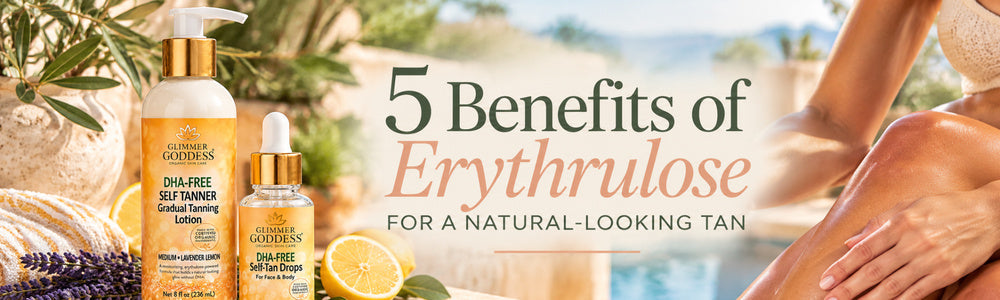
5 Benefits of Erythrulose for a Natural-Looking Tan
Last Updated: October 26, 2026
Quick Summary
Erythrulose tanning delivers five benefits: a softer, more golden color, gradual development you can control day by day, the potential for more even-looking fading, a DHA-free option for those who prefer to avoid DHA, and no UV exposure at all. Expect three to five days of daily application to reach a visible, even tan.
- Erythrulose reacts with skin proteins more slowly than DHA, so color builds over days instead of hours.
- A 2026 Journal of Drugs in Dermatology review reports erythrulose combined with DHA can produce a more homogeneous, natural-looking, longer-lasting tan.
- Exfoliate 24 hours before your first application, not the same day, and moisturize dry zones before applying.
- Patch test on the inner forearm 24 to 48 hours before a full-body application if you have reactive skin.
- A self-tanner does not replace sunscreen, so keep your broad-spectrum SPF routine unchanged.
Table of Contents
- What Erythrulose Is and How Erythrulose Works in Self-Tanner
- Benefit 1: A More Natural-Looking, Golden Color
- Benefit 2: Gradual Color Development You Can Control
- Erythrulose vs DHA: How the Two Tanning Agents Compare
- Benefit 3: Potential for Even-Looking Fading
- How Long Erythrulose Takes to Develop
- Benefit 4: DHA-Free Choice and Benefit 5: No UV Tanning
- Choosing an Erythrulose Self-Tanner for Your Routine
- Frequently Asked Questions
What Erythrulose Is and How Erythrulose Works in Self-Tanner
Erythrulose is a plant-derived tanning sugar that reacts with proteins in the skin's surface to gradually produce a golden-brown color.
The ingredient belongs to the same family of self-tanning sugars as dihydroxyacetone, though it behaves quite differently in practice. A review of common tanning methods notes that erythrulose used alone takes longer to produce a tan, fades quicker, and can look redder than brown.
Glimmer Goddess has built a DHA-free self-tanning line around erythrulose, and the brand's experience matches the research: this ingredient rewards patience, not speed.
The Reaction That Creates Color
Erythrulose reacts with amino acids in the outermost layer of skin, forming brown-toned pigments. Because that reaction moves more slowly than DHA's, color arrives gradually over several days rather than overnight.
Benefit 1: A More Natural-Looking, Golden Color
The first benefit is color quality. Erythrulose develops into softer, more golden tones that read as sun-kissed rather than obviously tanned.
That matters for anyone who has watched a self-tanner turn orange in the first hour.
Used alone, erythrulose skews lighter and warmer. Many people find that preferable for everyday wear, especially on fair or cool-toned skin where deep bronze looks artificial.
Benefit 2: Gradual Color Development You Can Control
Control is the second benefit. Erythrulose develops over days rather than hours, so you can stop applying when the shade looks right.
Apply daily, check the mirror each morning, and stop when satisfied. Miss a day and the color holds at its current depth.

Glimmer Goddess sells a deluxe sample of its organic DHA-free self-tanner for anyone who wants to test how erythrulose behaves on their own skin before committing to a full bottle.
Erythrulose vs DHA: How the Two Tanning Agents Compare
Erythrulose and DHA are both self-tanning sugars but differ in speed, tone, and wear. DHA acts fast, often within hours, producing deeper brown tones; erythrulose acts slowly and leans golden.
| Feature | Erythrulose | DHA |
|---|---|---|
| Speed of color | Develops over days | Visible within hours |
| Tone | Golden, softer | Deeper brown |
| Fade pattern | Gradual, even | Can patch as it lifts |
| Typical use | DHA-free formulas or blends | Standalone or blended |
Neither ingredient is better in absolute terms. The choice depends on whether the priority is speed or control. For readers who want the longer explanation, Glimmer Goddess publishes a DHA-free self-tanner guide that walks through how these ingredients behave.
Erythrulose-Only vs DHA-and-Erythrulose Formulas
An erythrulose-only formula offers a slower-developing DHA-free option and may avoid the characteristic odor often associated with DHA. A blended formula gets faster color plus the smoother fade erythrulose contributes.
Watch out: expecting same-day color from an erythrulose-only product leads to over-application and uneven patches. Read the label and match expectations to the formula.
Benefit 3: Smoother Fading and Better Tan Longevity
Because erythrulose color develops in layers over several days, it tends to lift in layers too, fading more evenly instead of going patchy around the elbows and knees.
Longevity depends on skin turnover and aftercare: moisturize daily and avoid aggressive exfoliation once color develops. Some fading is unavoidable, since self-tan color sits in the outermost skin cells and sheds with them.
How Long Erythrulose Takes to Develop
Erythrulose typically takes three to five days of daily application to reach a visible, even tan, the single most important thing to understand before you start.
The first twenty-four hours show little change; days two and three bring the shift most people notice. By day four or five, color has settled into its final depth. Stop at day three because you like the shade, and it holds roughly there until skin turnover fades it.
Preparation: The Step That Decides Your Result
Most streaking and patchiness comes from prep, not the product. A practical routine:
- Exfoliate 24 hours before your first application, not the same day. Use a gentle physical or chemical exfoliant to smooth dry patches on elbows, knees, ankles, and wrists. Freshly exfoliated skin takes color more evenly.
- Shave or wax at least a day ahead. Hair removal opens the skin slightly, and applying self-tanner immediately after can cause stinging or darker patches in those areas.
- Moisturize dry zones, elbows, knees, knuckles, ankles, and any flaky areas, right before application. Dry skin absorbs more product and turns darker.
- Apply to clean, dry skin in a room that is not steamy. Humidity and sweat during development are common causes of uneven color.
Application: Even Coverage With a Slow-Developing Formula
Because erythrulose builds over days, technique matters more than speed:
- Use a mitt or gloves. Hands and fingers pick up color fast and are the most common giveaway of a self-tan.
- Work in sections, legs, then torso, then arms, and use a consistent amount per section. More product means more color, so uneven amounts mean uneven depth.
- Blend the edges at the wrists, ankles, and hairline with a damp cloth or a light layer of moisturizer.
Troubleshooting: Streaks, Patches, and Uneven Fading
Even with good prep, issues happen. How to handle the most common ones:
| Problem | Likely cause | Fix |
|---|---|---|
| Streaks on legs or arms | Uneven application or overlapping strokes | Exfoliate gently and reapply a thin, even layer to the whole area, spot-fixing rarely blends |
| Dark patches on elbows, knees, ankles | Dry skin absorbing extra product | Exfoliate and moisturize those zones before the next application |
| Orange or overly warm tone | Too many layers too fast, or a formula mismatch | Skip a day, let color settle, and reassess before adding more |
| Patchy fade around day 5-7 | Skin turnover plus dry patches | Moisturize daily and exfoliate gently once fading starts to even it out |
| No visible color after 3 days | Formula is erythrulose-only and development is still underway, or application was too light | Continue daily application through day 5 before concluding it is not working |
Keep a simple log for your first cycle: date applied, areas covered, and how the color looks each morning. Erythrulose rewards a little record-keeping, and it makes the second cycle much easier to dial in.
Organic Self Tanner – Fast Bronze Glow →
Erythrulose-Only vs. DHA-and-Erythrulose: A Decision Guide
The development timeline changes with the formula, and the trade-offs matter:
- Erythrulose-only formulas develop over three to five days, lean golden and softer in tone, and fade gradually. They suit people who want maximum control, prefer a subtler everyday glow, or are avoiding DHA. The trade-off is patience, and the risk of over-applying if you expect same-day color.
- DHA-and-erythrulose blends start showing color within hours and reach full depth faster, with erythrulose contributing a smoother fade and a warmer undertone. They suit event timelines and anyone who wants deeper color with less waiting. The trade-off is less granular control over depth.
A practical way to decide: if you have a date on the calendar, choose a blend and start two days out. For everyday wear, choose erythrulose-only and apply daily until the shade looks right. Either way, read the label, the formula, not the ingredient name alone, determines how fast and deep the color develops.
Skin-Type Suitability and Individual Variation
Results vary more with erythrulose than with fast-acting tanners, because color builds gradually and interacts with your skin's condition. Hydrated, well-exfoliated skin takes color more evenly; dry skin can develop patchiness.
This slower development is the trade-off for control: anyone on a tight deadline should know that going in, while anyone willing to plan ahead gets a tan that builds exactly to their preference.
Benefit 4: Gentler on Sensitive Skin and Benefit 5: No Sun Damage
Sensitive skin is the fourth benefit and sun safety the fifth, the two areas where erythrulose's slower chemistry most changes the user experience.
Why Erythrulose May Suit Reactive Skin
Erythrulose reacts more slowly with skin proteins than DHA, which is the main reason some people with reactive skin find erythrulose formulas easier to tolerate.
"Gentler" is not "risk-free," though. Individual tolerance varies with skin condition, barrier health, and the rest of the formula.
If you have a diagnosed skin condition or are using prescription topicals, check with your dermatologist before adding any self-tanner. Erythrulose is a cosmetic ingredient, not a treatment, and it cannot address an underlying skin issue.
It also helps to separate two different risks that get conflated online:
- Irritation risk comes from how your skin reacts to the formula, the tanning sugar, preservatives, fragrance, or other ingredients.
- Sun-damage risk comes from UV exposure, and no self-tanner changes that.
A product can be gentle on reactive skin and still offer zero UV protection. Those are independent facts, and treating them as one is where a lot of confusion starts.
Readers with reactive skin can find more guidance in this DHA-free self-tanner article for sensitive skin, and product options are rounded up in this list of natural self-tanners for sensitive skin.
The Fifth Benefit: No UV Exposure
The fifth benefit: a cosmetic tan without the need for UV tanning or tanning beds. Self-tan color is cosmetic and sits in the outermost layer of skin, shedding naturally over time, a meaningful difference from a UV tan, which involves DNA-level changes in skin cells.
Realistic Sun-Protection Expectations
A self-tanner does not replace sunscreen. The appearance of a tan offers no protection from UV rays, a cosmetic tan and a UV-induced tan may look similar, but neither is a substitute for broad-spectrum SPF.
This is the most common misunderstanding about sunless tanning: anyone spending time outdoors still needs broad-spectrum sunscreen, reapplied as directed, regardless of how dark their self-tan looks.
Erythrulose can be a good fit for reactive skin and it avoids UV exposure entirely, but it is a color cosmetic, not a sunscreen. Patch-test first, and keep your SPF routine unchanged.
Choosing an Erythrulose Self-Tanner for Your Routine
Match the formula to the goal. Fast color for an event calls for a DHA-and-erythrulose blend. Everyday glow and maximum control call for an erythrulose-only product applied daily.
Glimmer Goddess makes both. The Fast Bronze Glow self-tanner combines DHA and erythrulose for color that starts within hours, while the DHA-Free Self Tanner for Sensitive Skin builds gradually over three to five days.


- Best for events: Fast Bronze Glow, for visible color within hours
- Best for beginners: the DHA-free sensitive skin formula, forgiving and slow-building
- Best for faces: Organic DHA-Free Tanning Drops used as directed for a customizable glow
Ready to browse the full range? The organic self-tanning collection lays out every option side by side.
Frequently Asked Questions
What oil gives the darkest tan?
No oil reliably creates a safe, darker tan. Oils without adequate SPF can increase UV exposure and the risk of sunburn, premature aging and skin cancer. For deeper-looking color without deliberate sun exposure, choose a sunless tanner and build the shade according to the product instructions. Glimmer Goddess DHA-Free Self Tanner develops gradually over approximately 3–5 days.
What does Jennifer Aniston use for tanning?
Jennifer Aniston has discussed using spray tans instead of sun tanning, and in an older interview mentioned L’Oréal Sublime Bronze Self-Tanning Towelettes. Those statements are historical and do not confirm what she uses today. A sunless tanner is a way to achieve cosmetic color without intentionally tanning in UV light.
Does vitamin D3 make you more tanned?
No. Taking vitamin D3 does not make your skin produce a tan. UV exposure can stimulate melanin production, while vitamin D is a nutrient important for health; these are separate processes. Do not increase sun exposure to try to improve vitamin D levels or skin color. If you have concerns about vitamin D, ask your healthcare professional about testing and dietary or supplemental sources.
Is erythrulose better than DHA?
Neither is universally better; they behave differently. A 2015 review in the Journal of Clinical and Aesthetic Dermatology notes erythrulose alone takes longer to produce a tan and fades quicker than DHA. A 2026 Journal of Drugs in Dermatology review reports that erythrulose combined with DHA can produce a more homogeneous, natural-looking, and longer-lasting tan. If you want fast, deep color, DHA leads. If you want a gradual, natural-looking erythrulose tanning result, erythrulose or a blend may suit you better.
How long does erythrulose take to develop?
Erythrulose develops more slowly than DHA. Sources describe its reaction as slower, with a lighter tan than DHA. In practice, erythrulose-based formulas often build color over several days of daily application rather than within hours. Glimmer Goddess DHA-free options, for example, are designed to build gradually over 3-5 days, with a recommendation to apply daily until you reach your ideal shade, then maintain 2-3 times per week.
Does erythrulose cause an orange-looking tan?
Erythrulose is often chosen to avoid orange-looking results. One 2015 review notes erythrulose used alone can look redder than brown, while the 2026 Journal of Drugs in Dermatology review associates erythrulose combined with DHA with a more natural-looking result. Color outcome depends on formulation, your skin tone, and application. Patch-testing and building color gradually are the most reliable ways to judge how a specific product looks on you.
Can erythrulose be used without DHA?
Yes. Erythrulose is a standalone self-tanning ingredient, and DHA-free formulas built on erythrulose are widely available. These suit people who want to avoid DHA or prefer a gradual build. Keep in mind that erythrulose alone develops more slowly and may fade sooner than DHA, so daily application is usually needed to reach and hold your target shade.
Does erythrulose make a tan last longer?
The evidence is mixed. The 2026 Journal of Drugs in Dermatology review attributes longer-lasting results to erythrulose combined with DHA, not to erythrulose alone. A separate 2015 review found erythrulose used by itself fades quicker than DHA. If longevity is your priority, a DHA-and-erythrulose blend has the stronger supporting evidence. Regular moisturizing and avoiding harsh exfoliation after color develops can help any sunless tan wear more evenly.
Building a believable glow takes the right formula and a little patience with the development timeline. Glimmer Goddess handcrafts vegan, cruelty-free self-tanners with certified organic ingredients in small batches, offering both fast-developing blends and gradual DHA-free options, plus a 60-day return window. Get started with Glimmer Goddess and find the shade that develops on your schedule.