




How to Layer Dark Spot Ingredients: AM & PM Routine
A dark-spot routine works best when each product has a clear job. Instead of stacking every brightening ingredient at once, build around one targeted serum, daily sun protection, and only the additional actives your skin can tolerate.
The American Academy of Dermatology recommends sun protection as the foundation of dark-spot care and lists ingredients such as vitamin C and retinoids among options that may help improve uneven pigmentation. See AAD dark-spot guidance.
How should you layer dark-spot skincare?
A simple order is:
- Cleanser.
- One primary treatment serum.
- Moisturizer if needed.
- Broad-spectrum SPF 30 or higher in the morning.
If you use more than one brightening ingredient, add them gradually rather than starting several products at once.
A simple morning routine for dark spots
1. Cleanse gently
Use a gentle cleanser and avoid scrubbing. Irritation can make post-inflammatory hyperpigmentation more noticeable, especially in deeper skin tones.
2. Use one brightening serum
Vitamin C is a common morning option. The AAD notes that vitamin C can help with dark spots and recommends applying vitamin C after cleansing and before sunscreen. See AAD vitamin C guidance.
The Organic Vitamin C Serum 20% – Brightening Treatment with Hyaluronic & Ferulic Acid is a verified Glimmer Goddess option for shoppers who want a vitamin-C-centered brightening step.
3. Moisturize if needed
Use a moisturizer that keeps your skin comfortable without adding unnecessary irritation.
4. Finish with sunscreen
Use broad-spectrum SPF 30 or higher. For people especially prone to hyperpigmentation, the AAD recommends considering a tinted sunscreen with iron oxide because visible light can worsen dark spots.
A simple evening routine for dark spots
1. Cleanse
Remove sunscreen, makeup, and daily buildup with a gentle cleanser.
2. Use one targeted treatment
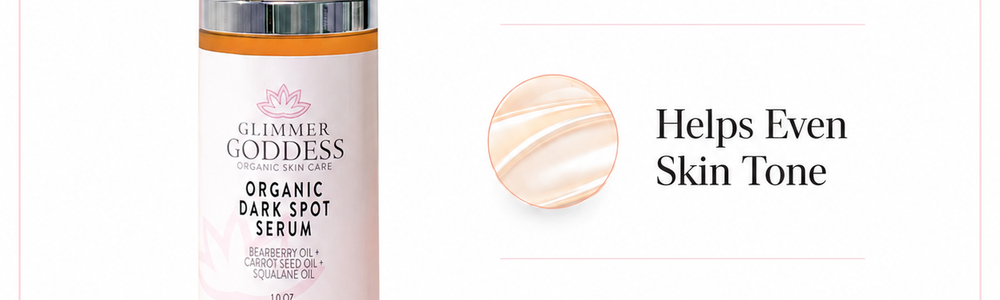
The Organic Dark Spot Serum – Fade Hyperpigmentation & Even Skin Tone is a verified GG product formulated with alpha arbutin, plant-based vitamin C, niacinamide, and botanical brightening ingredients.
Its appropriate cosmetic role is to help improve the appearance of visible dark spots and uneven tone. It should not be presented as a prescription treatment for melasma or as a guaranteed fast-fade product.
3. Moisturize
Finish with moisturizer if your skin needs it. A comfortable barrier is important because irritation can make pigmentation harder to manage.
Can vitamin C and niacinamide be used together?
Yes. The old rule that vitamin C and niacinamide must never be used in the same routine is outdated.
You can use them together if your formulas and skin tolerate the combination. The practical issue is not ingredient incompatibility so much as avoiding too many active products at once.
Where do retinoids fit?
Retinoids can help with mild pigmentation irregularities and uneven texture. The AAD recommends starting slowly because retinoids can cause irritation, and irritation itself can trigger dark marks in some skin tones.
If you use a retinoid, it is usually simplest to use it at night and avoid introducing multiple strong actives at the same time.
Retinoids should not be used during pregnancy.
Do you need exfoliation?
Not necessarily. AHAs and BHAs can be useful for texture and certain types of congestion, but they are optional in a dark-spot routine.
If you use an exfoliant, avoid combining several acids, scrubs, and retinoids if your skin becomes red, tight, or stingy.
How many brightening products should you use?
Usually fewer than you think. A good starting point is one main brightening serum plus sunscreen.
If your skin tolerates that routine well and you still have a specific concern, add one additional product at a time.
What order should dark-spot ingredients go in?
Follow each product’s directions, but a practical order is generally:
| Step | Morning | Evening |
|---|---|---|
| 1 | Cleanser | Cleanser |
| 2 | Vitamin C or other brightening serum | Dark-spot serum or retinoid |
| 3 | Moisturizer if needed | Moisturizer |
| 4 | Broad-spectrum SPF 30+ | — |
How long should you wait between layers?
There is no universal need to wait several minutes between ordinary skincare products. Apply the next step once the previous product has spread comfortably, unless the product directions tell you otherwise.
How long do dark spots take to fade?
There is no single timeline. The AAD notes that superficial dark spots may take months to fade after the cause is controlled, while deeper pigmentation can take much longer.
That is why sunscreen and consistency matter more than chasing a fixed “6-week” promise.
What if the dark spots are melasma?
Melasma is a specific pigmentation disorder and often needs a more specialized treatment plan. The AAD notes that treatment may include prescription medications, procedures, and strict sun protection.
If you suspect melasma, a dermatologist can help confirm the diagnosis and recommend treatment appropriate for your skin tone and triggers.
Common dark-spot routine mistakes
- Starting vitamin C, retinoid, exfoliating acid, and dark-spot serum all at once.
- Skipping sunscreen.
- Scrubbing pigmentation aggressively.
- Continuing a product that repeatedly burns or stings.
- Assuming stronger percentages always work faster.
- Using products that promise permanent or overnight removal.
Frequently asked questions
Should vitamin C be used in the morning or at night?
Either can be possible, but morning use is common because it layers naturally before sunscreen and provides antioxidant support.
Can I use a dark-spot serum and vitamin C in the same routine?
Sometimes. If both products are well tolerated, they may be compatible. If your skin is reactive, use one in the morning and one in the evening or introduce them separately.
Can I use retinol with a dark-spot serum?
Possibly, but irritation risk increases when several active products are combined. Start slowly and separate them if your skin becomes red, dry, or stingy.
Do I need exfoliation to fade dark spots?
No. Exfoliation is optional. Sunscreen and a well-chosen brightening treatment are more important foundations.
When should I see a dermatologist?
See a dermatologist if pigmentation is rapidly changing, difficult to identify, persistent despite a reasonable routine, or may be melasma or another skin condition.
Related Glimmer Goddess guides
- Skincare for Dark Spots: Ingredients, Routine & What to Expect
- Sunscreen for Dark Spots: SPF, Tinted Sunscreen & Routine
- Face Brightening Cream Guide 2026: Ingredients, SPF & Routine
- Explore Skincare by Skin Concern
This article is for general skincare education and is not a diagnosis or substitute for medical care.