




Dark Spot Removal Cream: Dermatologist-Informed Guide
There is no single “best” dark spot removal cream for everyone. The right approach depends on what is causing the discoloration, how your skin responds to products, and whether the spot is truly a cosmetic pigmentation concern. Daily sun protection and a gentle, consistent routine are usually more important than chasing a dramatic ranking or a fast-fade promise.
For a step-by-step overview, see our Skincare for Dark Spots: Ingredients & Routine Guide.
Why dark spot products should not be ranked like a leaderboard
Dark marks can have different causes, including post-inflammatory hyperpigmentation after acne or irritation, sun-related discoloration, and melasma. Because the cause matters, a cosmetic serum, a prescription treatment, and an in-office procedure are not interchangeable.
The American Academy of Dermatology advises identifying what is triggering the discoloration and using gentle skin care because irritation itself can contribute to new dark spots. Read the AAD's guidance on fading dark spots.
If you are unsure what type of discoloration you have, our guide to dark spots on the face explains common causes and when a dermatologist should take a closer look.
Start with sun protection
Sun protection is foundational in a dark-spot routine. The AAD recommends broad-spectrum SPF 30 or higher. For people prone to hyperpigmentation, especially melasma or discoloration in deeper skin tones, a tinted sunscreen containing iron oxide can also help reduce visible-light exposure.
Use sunscreen according to the label and reapply during extended outdoor exposure, swimming, or sweating. You can also review our Natural & Organic Skincare by Skin Concern guide for additional routine-building help.
Which ingredients are commonly used for visible dark spots?
The AAD lists several over-the-counter ingredients that may help improve the appearance of dark spots, including vitamin C, azelaic acid, glycolic acid, and kojic acid. What matters in practice is the complete formula, how consistently it is used, and whether your skin tolerates it without irritation.
Vitamin C
Vitamin C is commonly used in cosmetic skincare to support radiance and a more even-looking complexion.
Exfoliating acids
Ingredients such as glycolic acid can help improve the look of dullness and uneven surface tone. More exfoliation is not automatically better: overuse can irritate the skin, which may make discoloration more noticeable.
Niacinamide and alpha arbutin
Some cosmetic formulas use niacinamide and alpha arbutin as part of a brightening routine. These ingredients should be evaluated as part of the finished formula rather than treated as a guarantee of a specific result.
For more help comparing formula types, see our Dark Spot Serum Guide 2026.
A verified Glimmer Goddess cosmetic option
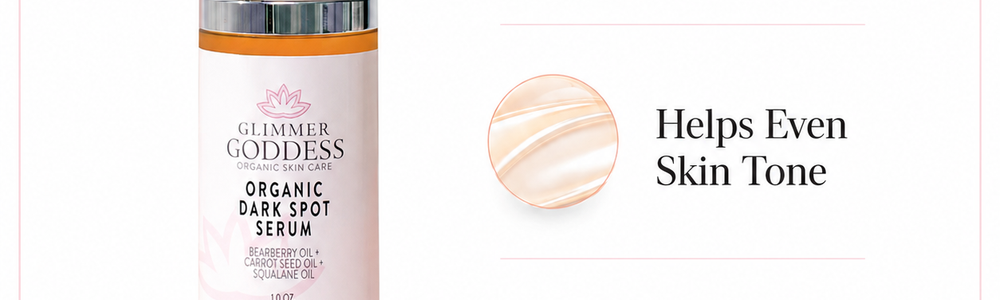
Our Organic Dark Spot Serum – Fade Hyperpigmentation & Even Skin Tone is an active Glimmer Goddess product formulated with alpha arbutin, plant-based vitamin C, and niacinamide. It is hydroquinone-free and is positioned as a cosmetic serum for improving the appearance of visible discoloration and uneven-looking tone.
It is not a prescription medication, does not replace dermatology care, and is not being presented as a universal “#1” treatment. Use it according to the product directions and pair a brightening routine with daytime sun protection.
How long can dark spots take to fade?
There is no reliable four-, six-, or eight-week promise that applies to everyone. The AAD notes that some superficial dark spots may take months to fade, while deeper discoloration can take considerably longer. Cause, depth, skin tone, irritation, sun exposure, and consistency all affect the timeline.
When prescription or in-office care may be appropriate
A dermatologist may recommend prescription topical treatment, a procedure, or another approach depending on the diagnosis and your skin. These options should not be compared with cosmetic products using fabricated scores or “winner” claims.
If a spot is new, changing, raised, bleeding, painful, or otherwise unusual, have it evaluated rather than assuming it is ordinary hyperpigmentation.
A simple dark spot routine
- Cleanse gently without scrubbing.
- Apply one targeted cosmetic brightening product according to its directions.
- Moisturize if your skin needs additional hydration.
- Apply broad-spectrum SPF 30+ every morning.
- Avoid stacking several irritating actives in an attempt to speed results.
Frequently asked questions
Is a cream better than a serum for dark spots?
No. Texture alone does not determine how well a product will fit your routine. Look at the finished formula, your skin type, and your tolerance.
Can a cosmetic dark spot product permanently erase discoloration?
No cosmetic product should promise permanent removal. New discoloration can develop with future sun exposure, inflammation, or other triggers.
Can irritation make dark spots look worse?
Yes. The AAD notes that irritating skin-care products can contribute to dark spots, particularly in people prone to post-inflammatory hyperpigmentation.
Do I still need sunscreen if I use a brightening product only at night?
Yes. Daytime sun protection remains a core part of managing visible discoloration.
The bottom line
Choose a dark spot corrector by verified ingredients, skin tolerance, realistic expectations, and daily sun protection—not by fabricated rankings. If the cause of a spot is unclear or the pigmentation is changing, a dermatologist should evaluate it before you intensify treatment.
This article is for general education and is not a diagnosis or substitute for medical care.