

Passer au contenu

Sign in to see your rewards

Sign in

Panier

Votre panier est vide

Article: Peptides in Skincare: Types, Benefits & How to Choose

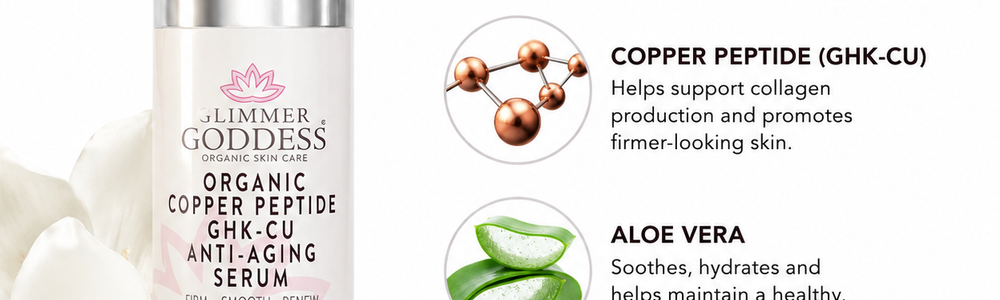
Glimmer Goddess Organic Copper Peptide GHK-Cu Serum featured in an evidence-based guide to peptide skincare.

Peptides in Skincare: Types, Benefits & How to Choose

Peptides are short chains of amino acids used in skincare formulas designed to support smoother, firmer-looking skin. Different peptides are used for different cosmetic goals, and the finished formula matters as much as the peptide name on the label.

Current reviews of topical GHK and GHK-Cu describe promising cosmetic potential, but they also note important limitations in skin penetration and the amount of clinical evidence available for finished topical products. That means peptide skincare should be evaluated by formula, texture, supporting ingredients, and realistic expectations rather than by hype alone. See the 2025 GHK review.

What do peptides do in skincare?

Peptides are commonly included in cosmetic products intended to improve the visible appearance of fine lines, firmness, texture, and hydration. The American Academy of Dermatology also lists peptides among ingredients used in cosmetic formulas for younger-looking skin. See AAD ingredient guidance.

However, peptides are not all identical. Their effects depend on the specific peptide, its concentration, the delivery system, and the rest of the formulation.

Common peptide types worth knowing

GHK-Cu / Copper Tripeptide-1

GHK-Cu is a copper-binding tripeptide used in cosmetic formulas for visible smoothing and firmness support. Research reviews describe promising biological activity, but also note that published clinical data and skin-permeation information are still limited.

Argireline® / Acetyl Hexapeptide-8

Argireline® is a cosmetic peptide frequently used in products aimed at the appearance of expression lines. It should not be described as “topical Botox” or presented as equivalent to an injectable treatment.

Matrixyl 3000

Matrixyl 3000 is a branded peptide complex commonly used in formulas designed to support smoother, firmer-looking skin. As with other peptides, performance depends on the finished formulation rather than the ingredient name alone.

Palmitoyl Tripeptide-5

Palmitoyl Tripeptide-5 is another cosmetic peptide used in anti-aging formulas intended to support a smoother-looking complexion.

A verified Glimmer Goddess multi-peptide serum

The Organic Copper Peptide Serum – Firming & Smoothing is an active Glimmer Goddess product formulated with GHK-Cu, Argireline®, Matrixyl 3000, Palmitoyl Tripeptide-5, vegan hyaluronic acid, and antioxidant-rich ingredients.

Its role in the routine is the concentrated serum step. The live product positioning supports cosmetic claims such as helping skin look smoother, firmer, more hydrated, and more refreshed. It is available in both a lightly scented essential-oil version and a fragrance-free version with no added essential oils.

Apply 1–2 pumps to clean, slightly damp skin in the morning and/or evening, then follow with moisturizer. In the morning, finish with sunscreen.

When a peptide moisturizer makes more sense

If your main priority is hydration with peptide support, the Organic Copper Peptide Moisturizer – Firming & Smoothing is the moisturizing step rather than a concentrated serum.

Its verified formula includes GHK-Cu, aloe vera, squalane, jojoba oil, rosehip seed oil, and provitamin B5. It is designed to hydrate and support smoother, firmer-looking skin without a heavy finish.

Serum vs moisturizer: which should you choose?

Choose When you want
Peptide serum A lightweight, concentrated peptide step beneath moisturizer
Peptide moisturizer Hydration plus peptide support in one cream step
Serum + moisturizer A complete layered peptide routine

For shoppers who want both steps together, the Copper Peptide Duo – Anti-Aging Serum & Moisturizer combines the two verified products in one routine.

How to layer peptide skincare

The AAD recommends keeping skincare routines simple because using too many products at once can increase irritation. A practical order is:

  1. Cleanse gently.
  2. Apply your serum or treatment.
  3. Apply moisturizer.
  4. Finish with sunscreen in the morning.

See the AAD skincare layering guidance.

Can peptides be used with vitamin C, niacinamide, or Vitamin A?

In many routines, yes. Peptides are commonly used alongside hydrating ingredients, niacinamide, antioxidants, and other cosmetic actives. There is no universal rule that peptides must be separated from vitamin C or Vitamin A in every formula.

The more important issue is skin tolerance. Introducing several active products at once can make it difficult to identify the cause of irritation. Start slowly, follow product directions, and simplify the routine if your skin becomes persistently red, itchy, or uncomfortable.

How long do peptide products take to work?

There is no universal peptide timeline. The AAD notes that most anti-aging products require time and consistency, and that many cosmetic products may need at least several weeks before visible changes can be evaluated. See AAD anti-aging guidance.

Avoid claims that any peptide product will deliver guaranteed lifting, wrinkle removal, or collagen changes within a fixed number of days.

How to choose a peptide product by skin type

Dry or mature-looking skin

Look for peptide formulas paired with humectants and emollients such as hyaluronic acid, squalane, panthenol, or plant oils.

Combination or oily skin

A lightweight peptide serum may be easier to layer without adding heaviness.

Sensitive or reactive skin

Patch test first and consider fragrance-free options. The AAD recommends testing new products on a small area before using them broadly. See AAD patch-test guidance.

Frequently asked questions

Are copper peptides better than other peptides?

Not universally. Copper peptides have interesting research behind them, but current reviews also identify gaps in clinical evidence and skin-permeation data. The best choice depends on the finished formula and your skincare goals.

Can I use a peptide serum every day?

Many cosmetic peptide serums are designed for daily use, but follow the individual product directions and reduce frequency if irritation develops.

Are peptide products suitable for sensitive skin?

They can be, but the full formula matters. Fragrance, essential oils, preservatives, and other actives may influence tolerance more than the peptide itself. Patch testing is a sensible first step.

Do peptides replace sunscreen?

No. Peptide products and sunscreen serve different purposes. Daily sun protection remains one of the most important steps for preventing visible premature skin aging.

Related Glimmer Goddess guides

This article is for cosmetic skincare education and is not a diagnosis or substitute for medical care.

Read more

Glimmer Goddess guide to dark spots, uneven skin tone, brightening ingredients, and daily sun protection.
Brightening Skincare

Skincare for Dark Spots: Ingredients, Routine & What to Expect

Learn which skincare ingredients may help improve the appearance of dark spots, how to build a simple routine, why tinted SPF matters, and when to see a dermatologist.

En savoir plus
Glimmer Goddess guide to sunscreen, daily SPF, and protecting skin prone to dark spots.
Dark Spots

Sunscreen for Dark Spots: SPF, Tinted Sunscreen & Routine

Learn how sunscreen helps protect dark spots from worsening, what SPF to choose, why tinted sunscreen with iron oxide matters, and how to build a simple daytime routine.

En savoir plus