




Color Correcting Dark Spots vs Treating Them: What’s the Difference?
Color correcting and treating dark spots are two different jobs. Color corrector is makeup for immediate visual camouflage. Dark-spot skincare is used consistently over time to improve the appearance of uneven tone.
The American Academy of Dermatology makes the same practical distinction for pigmentation concerns such as melasma: use treatment first, sunscreen next, and camouflage makeup last. See AAD melasma guidance.
What does color corrector do?
Color corrector uses contrasting tones to make discoloration look less noticeable under makeup. It changes how the color appears while you are wearing it; it does not remove pigment from the skin.
That makes it useful when you want:
- immediate cosmetic coverage;
- to neutralize blue-gray, purple, brown, or red discoloration;
- to use less concealer or foundation over a dark spot;
- a more even-looking makeup finish while skincare works over time.
Which corrector shade does what?
Peach
Peach can help visually neutralize blue-gray or brown discoloration on many fair-to-medium complexions.
Orange or red-orange
Deeper orange or red-orange shades are often more useful on medium-deep to deep complexions when discoloration looks blue-gray, purple-brown, or very dark.
Green
Green is mainly used to neutralize redness. It is usually not the best choice for brown hyperpigmentation.
Pink or bisque
Pink and bisque shades can help brighten some blue or purple discoloration on fair to light complexions.
For a full shade-by-skin-depth guide, see our Color Corrector for Dark Spots: Shade Guide by Skin Tone.
What does dark-spot skincare do?
Brightening skincare is designed to support a more even-looking complexion gradually. Common cosmetic ingredients include vitamin C, niacinamide, alpha arbutin, azelaic acid, kojic acid, and retinoids.
Unlike makeup, skincare does not provide instant pigment coverage. Its role is longer-term appearance improvement, and results depend on the cause and depth of the discoloration.
A verified Glimmer Goddess dark-spot option
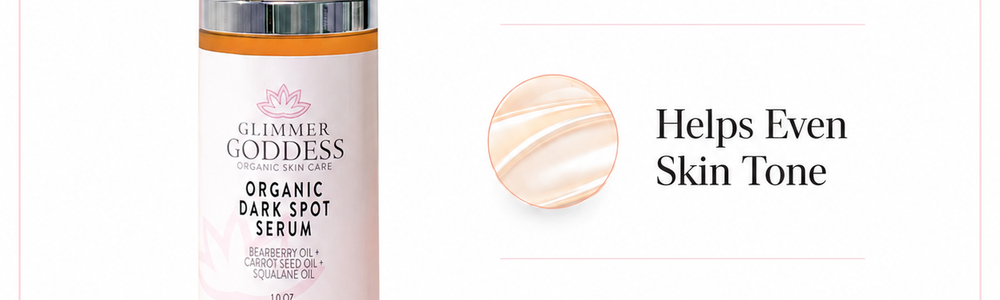
The Organic Dark Spot Serum – Fade Hyperpigmentation & Even Skin Tone is a verified live Glimmer Goddess skincare serum formulated with alpha arbutin, plant-based vitamin C, niacinamide, and botanical brightening ingredients.
Its appropriate cosmetic role is to help improve the appearance of visible dark spots and uneven tone over time.
It is not tinted, does not come in corrective shades, and does not provide makeup coverage.
Can you use color corrector and dark-spot skincare together?
Yes. They can work in the same routine because they solve different problems.
A practical order is:
- Apply your skincare treatment.
- Apply moisturizer if needed.
- Apply sunscreen.
- Apply color corrector only where needed.
- Finish with concealer or foundation if desired.
The AAD specifically recommends the order melasma medication → sunscreen → camouflage makeup for people using makeup to cover pigmentation while treatment works.
Why sunscreen matters in both approaches
Sunscreen sits between skincare and makeup because it helps prevent pigmentation from getting darker while also protecting the skin from UV exposure.
For dark spots and melasma, the AAD recommends broad-spectrum SPF 30 or higher and notes that tinted sunscreen containing iron oxide can provide additional protection from visible light, which can worsen hyperpigmentation.
Immediate coverage vs. long-term improvement
| Goal | Color Corrector | Dark-Spot Skincare |
|---|---|---|
| Works immediately? | Yes, cosmetically | No |
| Provides makeup coverage? | Yes | No |
| Targets appearance over time? | No | Yes |
| Used before concealer? | Often | No—used during skincare |
What if the discoloration is melasma?
Melasma is a specific pigmentation disorder and often needs a more specialized plan. Dermatologists may use prescription medications, procedures, strict sun protection, and camouflage makeup depending on the individual.
If you are unsure whether a patch is melasma, post-acne pigmentation, a sun spot, or another condition, professional evaluation is more useful than trying to cover or treat it blindly.
Common mistakes to avoid
- Expecting corrector to fade pigmentation.
- Expecting a non-tinted serum to cover dark spots immediately.
- Using green corrector on brown or gray discoloration.
- Applying makeup before sunscreen.
- Skipping sunscreen because the pigmentation is covered.
- Using products that promise permanent removal in a few days.
Frequently asked questions
Does color corrector fade dark spots?
No. Standard corrector is makeup. It changes how discoloration looks while you are wearing it.
Does dark-spot serum cover discoloration immediately?
No. A non-tinted serum does not provide cosmetic coverage.
Should sunscreen go before corrector?
Yes. Sunscreen is part of skincare and should generally be applied before makeup.
Can green corrector cover brown spots?
Usually not well. Green is designed mainly for redness. Peach, orange, or red-orange shades are more commonly used for brown, blue-gray, or purple discoloration depending on skin depth.
Can I use a dark-spot serum under makeup?
Yes, if the product directions allow it and the formula layers well. Apply skincare first, then sunscreen, then makeup.
Related Glimmer Goddess guides
- Color Corrector for Dark Spots: Shade Guide by Skin Tone
- How to Layer Dark Spot Ingredients: AM & PM Routine
- Sunscreen for Dark Spots: SPF, Tinted Sunscreen & Routine
- Explore Skincare by Skin Concern
This article is for general skincare and makeup education and is not a diagnosis or substitute for medical care.