


7 Best Natural Self-Tanners for Sensitive Skin
Table of Contents
- Natural Self-Tanners for Sensitive Skin: What Sets Them Apart
- Quick Comparison: Formula Types and Price Points
- Best Facial Self-Tan for Sensitive Skin
- Self-Tanner for Eczema-Prone Skin: Gradual Formulas That Hydrate
- How to Patch-Test Self-Tanner Before Full Application
- How to Apply Self-Tanner Without Streaks or Irritation
- Conclusion: Finding Your Ideal Sensitive-Skin Self-Tanner
- Frequently Asked Questions
Last Updated: October 16, 2026
Natural Self-Tanners for Sensitive Skin: What Sets Them Apart
Sensitive skin and self-tanning don't have to be incompatible. According to researchers publishing in the National Library of Medicine's PubMed Central, dihydroxyacetone (DHA) is the primary active ingredient in most self-tanners, but it's not the only option, erythrulose offers a gentler, slower-building alternative that many people with reactive skin tolerate better.

Finding the right 7 best natural self tanners for sensitive skin means understanding what "natural" actually means, how different formulas behave on reactive skin, and which application methods minimize irritation risk. Glimmer Goddess has developed both DHA-free and traditional self-tanning options. This guide breaks down what works, what doesn't, and how to test products safely before committing to full application.
Quick Comparison: Formula Types and Price Points
Self-tanners for sensitive skin come in three main formats, each with different development speeds, ease of control, and irritation profiles. Before comparing them, it helps to understand what you're actually putting on your skin.
What "Natural" and "Organic" Actually Mean on a Self-Tanner Label
A common misconception is that "natural" or "organic" automatically means hypoallergenic or irritation-free. It doesn't. These terms describe sourcing and formulation philosophy, not a safety guarantee. Botanical extracts, essential oils, and plant-derived preservatives can still trigger reactions in reactive skin. Likewise, a product labeled "organic" may only contain a small percentage of certified organic ingredients, the label doesn't tell you how much.
A more useful approach is to read the ingredient list and ask three questions:
- What is the tanning agent? Dihydroxyacetone (DHA) is the most common active in self-tanners. Erythrulose is a slower-building alternative that some people with reactive skin tolerate better. DHA-free formulas typically rely on erythrulose or plant-based alternatives.
- What is the base? Aloe vera, jojoba oil, shea butter, and glycerin are hydrating bases that support the skin barrier. Alcohol-heavy bases and synthetic fragrance are more likely to cause stinging or redness.
- What is the preservative system? Any water-based product needs preservatives. Some people react to common preservatives, so if you've had reactions before, note which ones appear in products that didn't work for you.
Formula Type Comparison
| Formula Type | Development Time | Best For | Control Level | Key Ingredient Considerations |
|---|---|---|---|---|
| Gradual lotion (DHA-free) | 3-5 days | Beginners, reactive skin, eczema-prone areas | High, build slowly | Look for shea butter, aloe, and plant-based emollients; avoid synthetic fragrance |
| Gradual drops (DHA-free) | 3-5 days | Face, customizable intensity | Very high, adjust drop count | Should mix into your own moisturizer so you control the base |
| Fast-developing lotion (DHA + erythrulose) | 3-5 hours | Event-ready color, experienced users | Medium, less forgiving | Higher DHA concentration means higher irritation potential for reactive skin |
How to Choose Based on Your Skin's Needs
- If your skin reacts easily to new products: Start with a DHA-free gradual lotion or drops. The slower development gives you time to stop if irritation appears.
- If you have eczema or a compromised barrier: Prioritize formulas with barrier-supporting ingredients like shea butter and aloe. Apply only to calm, well-moisturized skin.
- If you've self-tanned before without issues: A DHA + erythrulose lotion offers faster results, but patch-test first if you're trying a new brand.
- If you want facial color: Drops mixed into your own moisturizer give you the most control over both intensity and the base formula.
Our Selection Criteria
To narrow down the options, we evaluated products on:
- Ingredient profile, whether the formula avoids common irritants like synthetic fragrance and drying alcohols, and whether it includes barrier-supporting ingredients.
- Tanning agent, whether it uses DHA, erythrulose, or a DHA-free approach, and how that affects sensitivity risk.
- Color quality, whether the result looks natural or tends toward orange, and how evenly it fades.
- Application control, how easy it is to adjust intensity, especially for facial use.
- Reported irritation, patterns in customer feedback about stinging, redness, or breakouts.
This isn't a lab-tested ranking. It's a practical framework based on ingredient analysis and common patterns in sensitive-skin self-tanning. Individual reactions vary, which is why patch testing remains the most important step regardless of which product you choose.
Best Facial Self-Tan for Sensitive Skin
Facial skin is thinner and more reactive than body skin, making it the highest-priority area for sensitivity testing. Drops offer unmatched precision here, you control the exact amount applied and can adjust intensity between applications.
Glimmer Goddess' Organic DHA Free Tanning Drops ($39.95) are completely odor-free, develop gradually over 3-5 days, and mix seamlessly with your existing moisturizer. The drops are formulated with plant-based tanning agents, organic aloe vera, and jojoba oil, ingredients that hydrate while color develops.

For customers preferring a lotion texture on the face, the DHA Free Self Tanner for Sensitive Skin - Glow ($44.95) works equally well on facial skin.
Self-Tanner for Eczema-Prone Skin: Gradual Formulas That Hydrate
Eczema-prone skin needs extra moisture and zero irritating ingredients. Gradual formulas are safer than fast-developing ones because slower color development means less chemical stress on compromised skin barrier.
Glimmer Goddess' DHA Free Self Tanner for Sensitive Skin - Glow ($44.95) contains shea butter and plant-based emollients while erythrulose builds color gradually.
For a dual-phase approach, the DHA-Free Self Tanner Bundle ($67.92) pairs a hydrating body lotion with customizable facial drops. This lets you apply a gentler lotion to eczema-prone body areas while controlling facial intensity separately.

What matters most: apply self-tanner only to skin that's currently calm and well-moisturized. If eczema is active, wait.
How to Patch-Test Self-Tanner Before Full Application
Patch testing is non-negotiable for sensitive skin. Even if a formula is labeled "gentle" or "for sensitive skin," individual reactions vary widely. Good Housekeeping's testing of self-tanner products has noted that sensitivity-specific picks still required individual verification, no single product works for everyone.
Why Patch Testing Matters More Than the Label
A "sensitive skin" label is a marketing signal, not a clinical guarantee. It usually means the formula avoids common irritants like synthetic fragrance or drying alcohol, but it doesn't mean your skin won't react. Reactions can come from the tanning agent itself, a preservative, a botanical extract, or a combination of ingredients. The only way to know how your skin responds is to test.
How to Patch-Test Self-Tanner Safely
-
Choose a hidden test area. The inside of your upper arm, behind your ear, or the underside of your wrist are ideal, visible enough to monitor color but hidden if something goes wrong.
-
Apply a small amount. Use roughly the size of a pea. Don't dilute it or mix it with anything; test the product as you'd actually use it.
-
Wait 24 hours minimum. Some reactions appear immediately (stinging, redness, itching). Others develop over hours as the tanning agent interacts with your skin. Watch for redness, swelling, hives, or a burning sensation.
-
Check color development. After 24 hours, assess both how your skin reacted and how the color developed. If you're happy with the reaction and the shade, proceed to full application. If there's any irritation, stop and wait 48 hours before trying a different product.
-
If the patch test passes, wait 48 hours before full application. This extra buffer ensures no delayed reaction occurs.
What to Do If You React
If you notice redness, itching, swelling, or burning:
- Wash the area immediately with lukewarm water and a gentle, fragrance-free cleanser.
- Apply a cool compress to soothe the skin.
- Avoid exfoliating or applying other actives to the area until it settles.
- Don't reapply the product. If the reaction is severe or doesn't improve within a few days, consult a healthcare provider.
- Note the ingredients. If you can identify which product caused the reaction, keep a record so you can avoid similar formulas in the future.
Realistic Expectations for Sensitive Skin
Self-tanners for sensitive skin are formulated to reduce irritation risk, but they can't eliminate it entirely. A few things to keep in mind:
- Self-tanner does not provide sun protection. It gives you color, not SPF. You still need sunscreen, especially if you're spending time outdoors.
- Reactive skin may still react. Even the gentlest formula can cause a reaction if your skin barrier is compromised or if you're using other actives like retinol or acids.
- Color may develop unevenly on compromised skin. Dry patches, eczema flare-ups, and healing breakouts absorb product differently, which can lead to patchy results.
- If you have a history of allergies or severe skin conditions, talk to a dermatologist before using any self-tanner.
How to Apply Self-Tanner Without Streaks or Irritation
Application technique matters as much as formula choice. Poor application causes streaks, uneven color, and sometimes irritation from product pooling on sensitive areas.
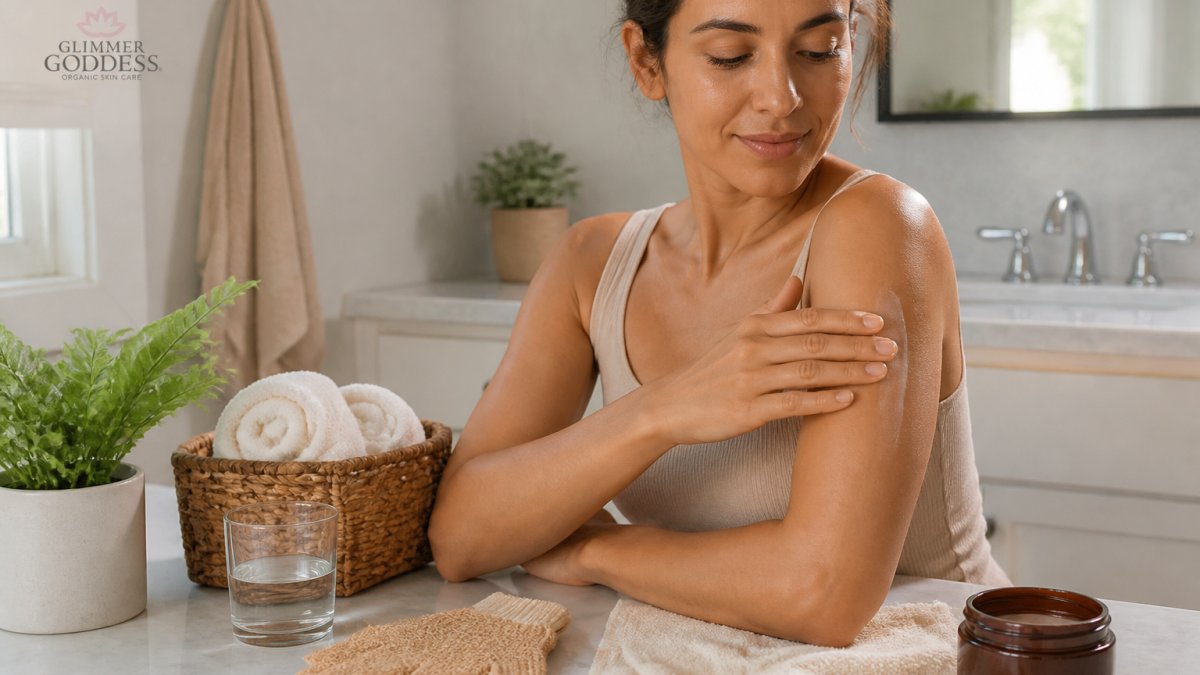
Preparation (24 hours before application):
- Exfoliate gently with a soft cloth or mild exfoliant. Remove dead skin so color develops evenly.
- Moisturize thoroughly. Hydrated skin accepts self-tanner more evenly than dry skin.
- Avoid other actives (retinol, acids, vitamin C) for 24 hours before self-tanning.
Application day:
- Start with clean, completely dry skin. Any residual water dilutes the product.
- Use minimal product. A little goes far, using too much causes streaking and increases irritation risk.
- Apply in circular motions, blending as you go. Don't rub; use light pressure.
- Pay special attention to elbows, knees, ankles, and hands, these areas absorb color faster and turn darker if over-applied.
- Wash your hands thoroughly immediately after application (unless using drops mixed into moisturizer).
- Allow the product to dry completely before dressing. Wet product on fabric causes staining.
Post-application:
- Avoid water for at least 6 hours (or follow product instructions).
- Skip exfoliation for 3-5 days while color develops.
- Moisturize daily. Hydration helps color fade evenly when it's time to re-tan.
For sensitive skin specifically, use less product than you think you need. You can always apply more the next day if color is too light. You cannot undo over-application.
Conclusion: Finding Your Ideal Sensitive-Skin Self-Tanner
Sensitive skin deserves a self-tanner that nourishes instead of irritating. The best products combine hydrating base ingredients with gentle tanning agents, giving your skin time to adjust while building believable color.
Glimmer Goddess' DHA-free self-tanning line addresses the core concerns of reactive skin: no harsh chemical smell, gradual color development that you control, and formulas enriched with organic aloe, jojoba oil, and plant-based botanicals. The DHA Free Self Tanner for Sensitive Skin - Glow ($44.95) and Organic DHA Free Tanning Drops ($39.95) let you start with patch testing, build color at your own pace, and stop anytime if irritation develops.
Frequently Asked Questions
What is the best self-tanner for sensitive skin?
The best natural self-tanners for sensitive skin use erythrulose or a DHA-erythrulose blend with hydrating ingredients like aloe vera, coconut oil, and shea butter. Look for formulas labeled as gradual-developing (3-5 days) rather than fast-developing, as they're gentler and more forgiving. Patch-test any new product on a small area first to ensure compatibility.
What self-tanner is best for eczema-prone skin?
For eczema-prone skin, choose self-tanners with DHA-free or low-irritant formulas. Gradual tanning drops mixed into your regular moisturizer offer the most control and allow you to skip days if your skin flares. Always apply to well-moisturized skin.
How can I patch-test self-tanner if I have sensitive skin?
Apply a small amount (about the size of a dime) to your inner wrist or behind your ear 24 hours before full application. Watch for redness, itching, burning, or any reaction over the next 24-48 hours. If no irritation appears, you can safely use the product on your body or face. This simple step prevents full-body reactions and helps you identify which formulas work for your skin.
Why do some self-tanners turn skin orange?
Orange tones typically occur when DHA (dihydroxyacetone) is the only tanning agent and the formula lacks erythrulose or other balancing ingredients. DHA can create warm, peachy tones if not blended properly or if applied unevenly. Natural self-tanners that combine DHA with erythrulose or use erythrulose alone tend to develop into more golden, sun-kissed shades rather than orange.