



Copper Peptides in Skincare: What the Evidence Supports—and What It Doesn’t
Copper peptides—especially GHK-Cu—are popular in firming and wrinkle-focused skincare. Laboratory research gives scientists good reasons to study them, but the clinical evidence for topical anti-wrinkle benefits is still much thinner than many product claims imply. That makes copper peptides promising cosmetic ingredients, not proven replacements for medical treatments or better-established anti-aging actives.
What Is GHK-Cu?
GHK is a naturally occurring tripeptide that can bind copper, forming GHK-Cu. Peptides are short chains of amino acids. In cosmetic formulas, GHK-Cu is used because laboratory research suggests roles in processes related to skin structure and repair.
Why Copper Peptides Get So Much Attention
Cell and laboratory studies have linked GHK-Cu with signaling involved in collagen-related processes, antioxidant activity and tissue repair. Those findings are biologically interesting, but they do not automatically tell us how much of a topical serum reaches its target in human skin or how large the visible benefit will be.
What the Human Evidence Shows
A recent review of topical GHK and its derivatives noted a surprising lack of strong clinical studies despite widespread use in anti-wrinkle products. The review specifically highlighted unanswered questions about skin permeability and real-world effectiveness.
An older split-face study after CO2 laser resurfacing found no significant objective difference in redness, wrinkles or overall skin quality between GHK-Cu treatment and the comparison side, although participants reported a subjective improvement in overall skin quality.
In other words: there is enough evidence to justify continued research, but not enough to promise dramatic wrinkle reversal.
Where a Copper Peptide Serum Fits
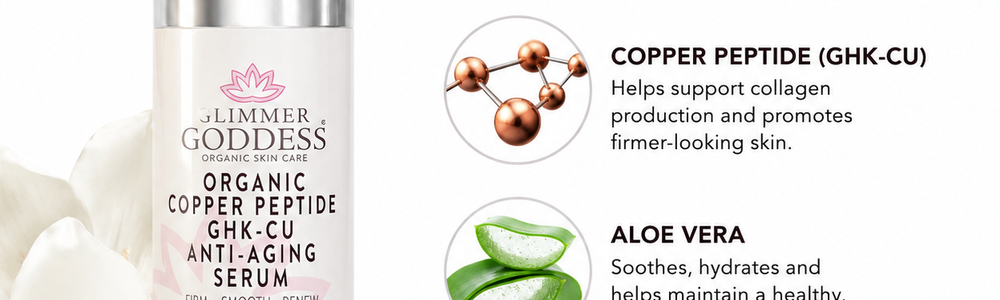
The current Organic Copper Peptide Serum – Firming & Smoothing is an active Glimmer Goddess® GHK-Cu serum. In a routine, it is reasonable to frame it as a cosmetic serum intended to support smoother, firmer-looking skin—not as a drug that rebuilds collagen on command or heals wounds.
How to Use Copper Peptides
- Cleanse gently.
- Apply the copper peptide serum according to the product directions.
- Follow with moisturizer as needed.
- Use sunscreen in the morning.
- Introduce one new active product at a time if your skin is sensitive.
If you use several serums, simplify rather than layering every active ingredient at once. Our skincare layering guide can help.
Can Copper Peptides Replace Vitamin A or Vitamin C?
They should be viewed as a different category, not a direct substitute with equivalent evidence. Vitamin A derivatives have a much larger clinical literature for photoaging, and topical vitamin C has its own evidence base. A routine does not need every ingredient; tolerance and consistency matter more than collecting actives.
Are Copper Peptides Safe for Sensitive Skin?
Many people tolerate peptide serums well, but any cosmetic can irritate. Patch test if you are reactive, avoid applying to broken skin unless directed by a clinician, and stop if you develop persistent burning, swelling or rash.
Frequently Asked Questions
Do copper peptides rebuild collagen?
Laboratory data suggest effects on collagen-related pathways, but current clinical evidence does not support promising a specific amount of collagen rebuilding from a cosmetic serum.
Do copper peptides heal scars?
Do not use a cosmetic copper peptide serum as a scar or wound treatment unless a healthcare professional recommends it for that purpose.
How long do copper peptides take to work?
There is no single clinically established timeline that applies to all products. Follow the individual formula’s directions and judge changes gradually.
The Bottom Line
Copper peptides are scientifically interesting and reasonable to use in cosmetic skincare, but marketing should stay proportional to the evidence. Expect supportive, gradual cosmetic benefits—not a guaranteed transformation.
Sources: review of topical GHK as an anti-wrinkle peptide; clinical study of topical copper tripeptide after CO2 laser resurfacing.