



AHA Mask vs. Enzyme Mask: Which Exfoliating Face Mask Fits Your Skin?
AHA masks and enzyme masks can both loosen dull surface buildup, but they are not the same treatment. Alpha hydroxy acids such as glycolic or lactic acid exfoliate through acid-driven chemical processes, while enzyme masks use proteolytic enzymes—often from fruits such as papaya or pineapple—to help break down surface proteins. Neither type is automatically “better”; the right choice depends on your skin’s tolerance and the rest of your routine.
What an AHA Mask Does
Alpha hydroxy acids are water-soluble acids used to exfoliate the outer skin surface. An AHA mask may make rough texture look smoother and dull skin look brighter, but effectiveness and irritation potential depend on the specific acid, concentration, pH, contact time and complete formula.
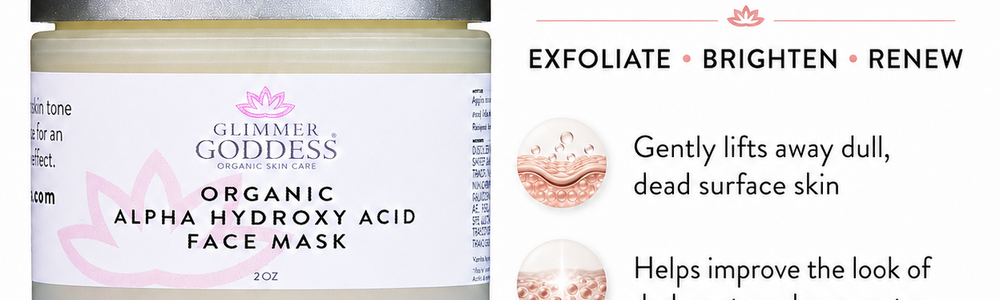
The current Organic AHA Face Mask – Renewing Treatment for Exfoliation & Glow is the active Glimmer Goddess® AHA mask option.
For a deeper AHA-only guide, see AHA Face Masks: Benefits, Risks & How to Use Them Safely.
What an Enzyme Mask Does
Enzyme masks commonly use ingredients such as papain from papaya or bromelain from pineapple. They help loosen surface buildup without relying on the same acid chemistry as AHAs.
The current Organic Papaya Pineapple Enzyme Face Mask – Gentle Exfoliating Treatment is an active enzyme-mask option.
“Enzyme” does not mean irritation-proof. Fruit-derived enzymes and the rest of the formula can still sting or trigger a reaction in sensitive skin.
AHA vs. Enzyme Mask: Quick Comparison
- AHA mask: more directly acid-based; strength depends heavily on pH and concentration.
- Enzyme mask: uses enzymes to loosen surface proteins; may feel gentler for some users but not universally.
- Very sensitive or compromised skin: either type can be too much during an irritated period.
- Experienced exfoliant users: an AHA mask may provide a more predictable acid-exfoliation step when used as directed.
How to Choose Based on the Rest of Your Routine
The biggest mistake is stacking exfoliation simply because each product is marketed as gentle.
- If you already use an AHA cleanser, exfoliating serum or peel, an additional AHA mask may be unnecessary.
- If you use Vitamin A treatments, benzoyl peroxide or prescription acne medications, ask your dermatologist or follow product directions before adding extra exfoliation.
- If your skin is currently sunburned, peeling, cracked or inflamed, skip exfoliating masks until it recovers.
Our broader guide to physical, chemical and enzyme exfoliation can help you compare methods.
Why Sunscreen Matters With AHAs
The FDA notes that AHAs can increase skin sensitivity to ultraviolet radiation while they are being used and for up to a week after stopping. Use sunscreen, protective clothing and shade as directed when AHAs are part of your routine.
How Often Should You Use an Exfoliating Mask?
There is no universal schedule. Follow the individual product directions and adjust based on your skin’s response. More frequent exfoliation is not automatically more effective. Persistent stinging, unusual redness, tightness or peeling are signs to reduce frequency or stop.
Before and After the Mask
- Cleanse gently.
- Apply the mask exactly as directed; do not extend the contact time to make it “stronger.”
- Rinse thoroughly.
- Follow with a simple moisturizer.
- Use sunscreen during the day.
Frequently Asked Questions
Is an enzyme mask safer than an AHA mask?
Not automatically. Many people find enzyme formulas gentle, but sensitivity depends on the individual formula and your skin.
Can I use both masks in the same week?
Possibly, but there is rarely a need to stack exfoliation. If you do use both, separate them and monitor for irritation rather than assuming more is better.
Can AHA masks erase wrinkles?
No mask can erase structural wrinkles. AHAs can improve surface texture and brightness, and some acid formulations have longer-term evidence for photoaging, but a rinse-off mask should not promise a facelift.
The Bottom Line
Choose an AHA mask when you want a defined acid-exfoliation step and your skin tolerates it; choose an enzyme mask when you prefer a different exfoliation approach. In either case, follow the formula directions, avoid over-layering exfoliants and protect skin from UV exposure.
Sources: U.S. FDA: Alpha Hydroxy Acids; American Academy of Dermatology: How to safely exfoliate at home.