



Skip to content

Sign in to see your rewards

Sign in

Cart

Your cart is empty

Article: Sunscreen for Dark Spots: SPF, Tinted Sunscreen & Routine

Glimmer Goddess guide to sunscreen, daily SPF, and protecting skin prone to dark spots.

Sunscreen for Dark Spots: SPF, Tinted Sunscreen & Routine

If dark spots or uneven-looking tone are a concern, sunscreen is one of the most important daily steps. Choose broad-spectrum SPF 30 or higher, apply it generously, and reapply as directed. For pigmentation that is influenced by visible light, dermatologists often recommend a tinted sunscreen containing iron oxide.

The American Academy of Dermatology notes that sunscreen can help prevent dark spots from worsening, and that tinted sunscreen with iron oxide offers additional visible-light protection that can be especially helpful for hyperpigmentation. See AAD guidance on dark spots.

What sunscreen should you look for if you have dark spots?

Start with the basics. The AAD recommends sunscreen that provides:

  • SPF 30 or higher
  • broad-spectrum protection against UVA and UVB rays
  • water resistance when appropriate for your activity
  • a texture you will apply consistently and in the recommended amount

If dark spots, melasma, or post-inflammatory hyperpigmentation are a major concern, a tinted sunscreen with iron oxide can add protection against visible light. Visible light can contribute to hyperpigmentation, particularly in darker skin tones.

Is mineral sunscreen better for dark spots?

Not automatically. Both mineral and organic-filter sunscreens can provide effective UV protection when they are broad-spectrum, SPF 30+, and used correctly. The best choice is one that suits your skin, offers the labeled protection, and is comfortable enough for consistent use.

For some people with sensitive skin, zinc oxide or titanium dioxide formulas may be easier to tolerate. But for dark-spot prevention specifically, the more important questions are whether the sunscreen offers adequate broad-spectrum protection, whether you apply enough, and whether a tinted iron-oxide formula is appropriate for your pigmentation concerns.

A verified Glimmer Goddess daily SPF option

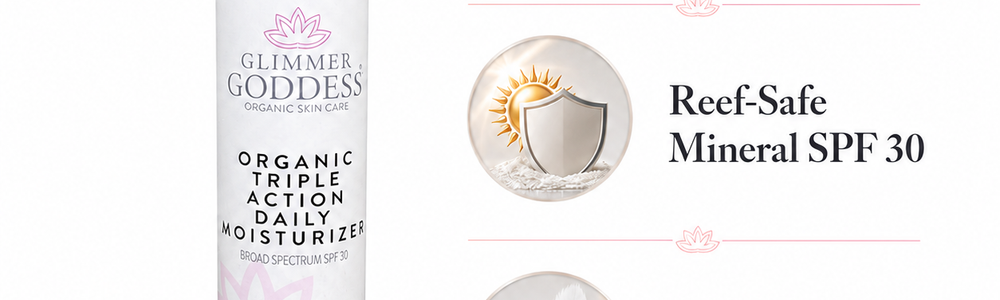
The Triple Action Daily Moisturizer – Organic SPF 30 is an active Glimmer Goddess product that combines daily facial hydration with mineral SPF 30 protection using non-nano zinc oxide.

It is designed as a streamlined morning moisturizer-and-sunscreen step. The live product information supports daily hydration, mineral sun protection, and a lightweight seasonal airless-pump version as well as a richer jar version when available.

This product is not a tinted iron-oxide sunscreen, so readers specifically concerned about visible-light-driven pigmentation may wish to discuss tinted sunscreen options with a dermatologist or choose a separate tinted SPF that meets their needs.

How sunscreen fits into a dark spot routine

Sunscreen helps protect skin from ongoing UV exposure that can make discoloration more noticeable. It should be paired with a gentle routine rather than treated as a product that “erases” existing spots on its own.

  1. Cleanse gently. Avoid aggressive scrubbing or over-exfoliation.
  2. Apply a targeted serum if you use one. Let it absorb according to its directions.
  3. Moisturize if needed.
  4. Apply sunscreen as the final morning skincare step.

For shoppers who want targeted cosmetic support for visible discoloration, the Organic Dark Spot Serum – Fade Hyperpigmentation & Even Skin Tone is formulated with alpha arbutin, plant-based vitamin C, and niacinamide. It should be used as directed and paired with appropriate daytime sun protection.

How much sunscreen should you use?

Under-applying sunscreen reduces the protection you receive. The AAD advises applying sunscreen to all exposed skin before going outdoors and reapplying approximately every two hours when outdoors, as well as after swimming or sweating according to the product directions. See the AAD application guide.

For any sunscreen, follow the Drug Facts or label directions for amount, timing, water resistance, and reapplication rather than relying on a universal “nickel-sized” estimate.

Do you need sunscreen on cloudy days?

Yes. UV exposure still occurs on cloudy days, so daily sun protection remains relevant. If your goal is to prevent dark spots from becoming more noticeable, consistency matters more than using sunscreen only on bright summer days.

What about sunscreen near windows?

UVA can pass through window glass, so people who spend significant time near sunny windows may still benefit from daily broad-spectrum sun protection. The AAD also notes that visible light can contribute to pigmentation in some skin tones.

Tinted sunscreen and iron oxide: why it matters

Tinted sunscreens contain pigments such as iron oxide. Dermatology guidance specifically highlights iron oxide because it helps protect against visible light, which can worsen dark spots and melasma in some people. Learn more about tinted sunscreen.

If hyperpigmentation is a significant concern, this is an important distinction: a standard untinted SPF can provide excellent UV protection, while a tinted iron-oxide sunscreen may add another useful layer of protection from visible light.

Common sunscreen mistakes that can undermine a dark spot routine

  • Applying too little sunscreen.
  • Skipping reapplication during extended outdoor exposure.
  • Relying on makeup with SPF as the only protection when too little is applied.
  • Ignoring the neck, ears, hairline, and other exposed areas.
  • Continuing to use a sunscreen that repeatedly stings or irritates your skin.
  • Assuming a higher SPF eliminates the need for reapplication.

Frequently asked questions

Can sunscreen fade dark spots?

Sunscreen is primarily protective. By reducing ongoing UV and, in the case of tinted iron-oxide sunscreen, visible-light exposure, it can help keep existing discoloration from becoming more pronounced and support a broader dark-spot routine. It should not be marketed as an instant dark-spot remover.

What SPF is best for dark spots?

Dermatologists generally recommend broad-spectrum SPF 30 or higher. For people particularly concerned about hyperpigmentation, a tinted formula containing iron oxide may offer additional visible-light protection.

Is SPF 50 always better than SPF 30?

Higher SPF can provide additional UVB protection, but no sunscreen blocks all UV radiation. Correct application, sufficient amount, and reapplication remain essential regardless of the SPF number.

Should I use sunscreen if I only use a dark spot serum at night?

Yes. Daytime sun protection is still important because UV and visible-light exposure can make discoloration more noticeable even if your targeted serum is used only at night.

Can sunscreen prevent every new dark spot?

No. Dark spots can have multiple causes, including inflammation, acne, hormonal changes, and other skin conditions. Sunscreen reduces an important trigger—light exposure—but it cannot prevent every form of discoloration.

Related Glimmer Goddess guides

This article is for general skincare education and is not a diagnosis or substitute for medical care. See a dermatologist for persistent or changing discoloration, melasma, or any new or unusual spot.

Read more

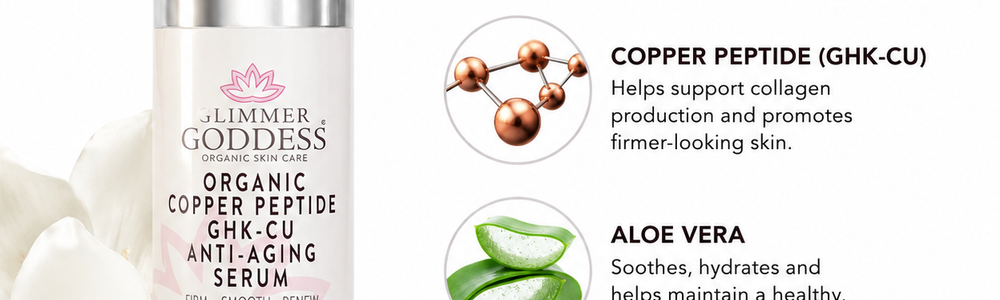
Glimmer Goddess Organic Copper Peptide GHK-Cu Serum featured in an evidence-based guide to peptide skincare.
Copper Peptides

Peptides in Skincare: Types, Benefits & How to Choose

Learn what peptides do in skincare, how GHK-Cu, Argireline® and Matrixyl 3000 differ, and how to choose between a peptide serum, moisturizer, or layered routine.

Read more
Glimmer Goddess editorial image illustrating serum and moisturizer pairing for a brighter-looking skincare routine.
Brightening Skincare

Face Brightening Cream Guide 2026: Ingredients, SPF & Routine

Learn what a face brightening cream can realistically do, which ingredients support radiance, how to pair moisturizer with targeted dark spot care, and why daily SPF matters.

Read more